


A clip from one of China’s biggest annual political events is casting fresh scrutiny on the extraordinary precautions surrounding leader Xi Jinping after it appeared to show staff giving his seat special attention before the meeting began.
The video, taken from Japanese broadcaster TBS’s coverage of the March 12 closing session of China’s Two Sessions and later widely shared on social media, quickly became a target of ridicule among Chinese-language users outside mainland China.
But beyond the mockery, the scene struck a deeper chord: At one of Beijing’s most carefully choreographed political gatherings, it appeared to offer a revealing glimpse of the unusual levels of control, deference, and security surrounding Xi.
A Carefully Staged Scene
The moment stood out because the Two Sessions, the annual meetings of China’s legislature and top political advisory body, held each March in Beijing, are among the country’s most tightly managed political events, where thousands of delegates gather to endorse priorities already set by the Chinese Communist Party. Reuters reported that this year’s meetings rolled out China’s main economic and political priorities, including a 2026 growth target of around 5 percent, a larger defense budget, and a broader push for AI and tech self-reliance.In the footage, one man believed to be part of Xi’s security detail appeared to briefly sit in Xi’s seat, inspect the desk and chair by hand, and lean down to check beneath the table before the session began. Another staff member took pens from a plastic bag and lined them up neatly, while a woman carefully wiped the tabletop, including the voting device, and the chair. Two other men appeared to use a ruler to measure the spacing between seats.
The clip also appeared to show Xi’s teacups being delivered separately, with two cups placed at his seat while other attendees appeared to have one.
Online Mockery Takes Off
That level of detail fueled a wave of sarcastic commentary online outside China.Some users joked that a small army had been deployed just to prepare one chair. Others said the scene made Xi look less like the head of a modern ruling party and more like an emperor surrounded by attendants. Still others framed it as a sign of deep insecurity—proof, in their view, that even inside Beijing’s Great Hall of the People, Xi is treated as a leader under constant protection.
The mockery centered not just on the security checks themselves, but on what critics saw as the sheer absurdity of the display: so much manpower devoted to a desk, a chair, and a few pens at a political event run entirely by the Chinese Communist Party.
A Wider Pattern Around Xi
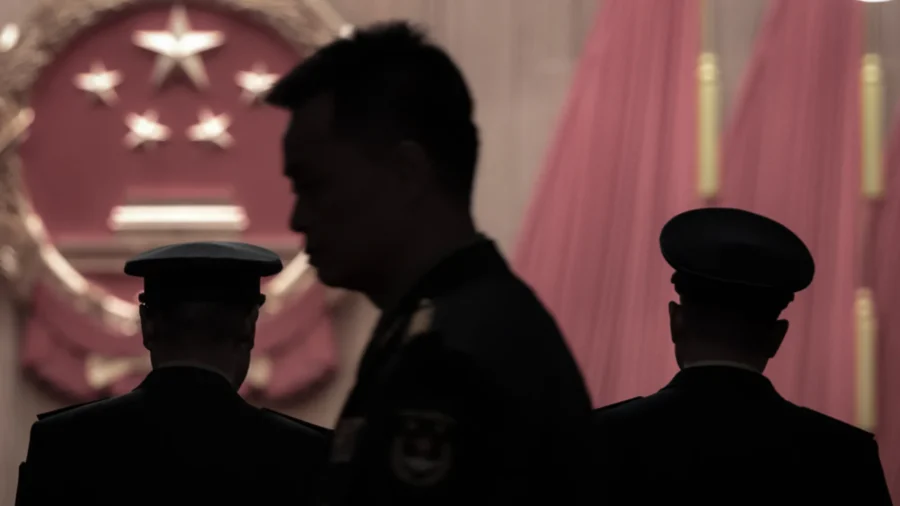
The footage also fed into a broader perception long associated with Xi’s public appearances: that they are wrapped in unusually heavy security. Reuters photos from this year’s Two Sessions showed security personnel stationed inside the Great Hall of the People ahead of the meeting, underscoring the tightly controlled atmosphere around one of Beijing’s most stage-managed political events.That scrutiny has surfaced before. During Xi’s 2022 visit to Hong Kong, the Chinese leader did not appear at the city’s traditional flag-raising ceremony. Local media said Xi stayed overnight in the southern city of Shenzhen, just across the border, rather than in Hong Kong itself, and traveled in vehicles brought from the mainland.
Other domestic trips by Xi have drawn similar scrutiny. During a March 2025 inspection tour of China’s southwestern provinces of Guizhou and Yunnan, online observers pointed to the heavy security around him and speculated, without verification, that he may have been wearing body armor.
More recently, state media images of Xi’s Feb. 6 appearance with retired military officials drew notice after several large uniformed security personnel were seen closely shadowing Xi as he greeted senior military retirees, a level of visible tension that some observers said had not been so apparent in similar events in previous years.
Overseas commentators have long pointed to the scale of such security arrangements as a sign of Beijing’s concern over Xi’s safety, with some arguing they reflect fears not only of external threats, but of instability within the system itself.
For critics of Beijing, the recent clip was more than just an awkward viral moment. It offered a revealing glimpse of a political system built around one man—and of the extraordinary caution, choreography, and deference surrounding him.