


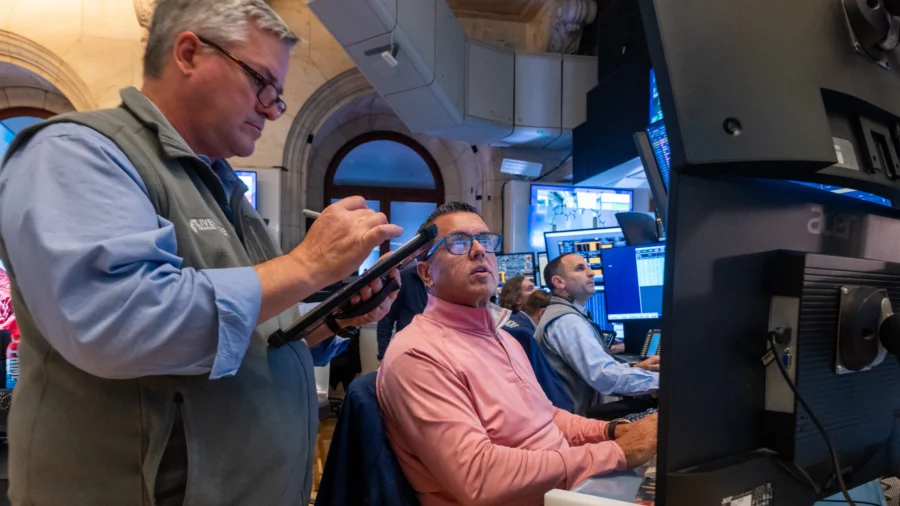
Equities experienced another turbulent week as concerns over valuations in AI-related stocks, anticipation of Nvidia’s earnings, mixed retail reports, and uncertainty around monetary policy kept markets on edge.
Stocks opened the week lower on Nov. 17 as selling in the tech sector resumed ahead of Nvidia’s earnings and the delayed payroll report slated for later in the week. Both were viewed as pivotal for the broader market.
Equity analysts view Nvidia’s performance as a proxy for the growth of the semiconductor industry and AI infrastructure spending, which have supported the tech rally. The payroll report is broadly monitored for signs of labor market strength or weakness and for its implications on monetary policy.
Selling pressure intensified late in the session as dip buyers remained cautious. All major indexes ended lower, led by the Russell 2000’s 1.94 percent decline and a 1.18 percent drop for the Dow.
Alphabet bucked the trend, rising by 3.11 percent on reports that Berkshire Hathaway invested $5 billion in Google’s parent company during the first quarter.
A lackluster earnings report from Home Depot on Nov. 18 added to the negative sentiment, sending the home improvement giant’s shares sharply lower and pulling broader markets down in early trading.
Losses eased as the day progressed, supported by bargain hunting and stable bond yields. Still, only the Russell 2000 managed a slightly positive close; the Dow, S&P 500, and Nasdaq remained in the red.
Markets rebounded on the morning of Nov. 19 on bargain hunting and a strong earnings report from Lowe’s, which beat forecasts and gave an upbeat outlook, easing some concerns over consumer spending.
“A December rate cut could be slipping away, because most policymakers seem worried about inflation stuck above 2 percent. Uncertainty is high due to lost data and the unclear impact of tariffs. There’s no consensus at the Fed with policymakers flying blind, but these minutes lean hawkish overall,” David Russell, global head of market strategy at TradeStation, told The Epoch Times.
Despite caution ahead of Nvidia’s anticipated results, markets broke a four-day losing streak, with the Dow, S&P 500, and Nasdaq closing higher. The Russell 2000 posted slight losses.
Nvidia’s strong earnings report after the market close revived enthusiasm for AI-related stocks on Nov. 20. Better-than-expected results from Walmart added further support, reinforcing expectations of resilient consumer spending.
A better-than-expected labor market report also boosted sentiment.
However, the strong data dampened hopes of a December rate cut—an outcome already priced into many high-valuation stocks.
Tech shares retreated sharply as investors reassessed interest-rate expectations. All major indexes reversed course and closed substantially lower, led by a 2.15 percent drop in the Nasdaq and a 1.74 percent decline in the Russell 2000.
Nvidia shares, up by nearly 5 percent at the open, finished down by 3.15 percent. Palantir fell by 5.85 percent.
“While Nvidia is a super profitable company with monstrously large free cash flows, it’s difficult to justify any further upside from current levels. All the good with Nvidia is priced in already, and that’s the big problem with Nvidia,” David Trainer, CEO of New Constructs in Nashville, told The Epoch Times.
Walmart held onto its early gains, closing up by 6.50 percent.
Volatility persisted on Nov. 21 as major indexes swung between gains and losses. Markets opened higher but turned lower minutes later as tech stocks retreated again, only to rebound sharply midday.
Despite the week’s turbulence, some analysts remained optimistic.
Mary Ann Bartels, chief investment strategist at Sanctuary Wealth, expects the S&P 500 to reach 7,500 by the end of next year.
“As we enter 2026, the equity market has had great performance since the lows of the bear market in 2022. We expect 2026 to be the reset year for market leadership in the big Growth Technology stocks,” Bartels said.
Meanwhile, she anticipates some pullback due to valuation compression. “We expect the Fed to pursue interest rate cuts, but seasonal pressure typically pushes interest rates higher into December and 1Q26, which could weigh on stock prices,” she added.