


China’s communist leader Xi Jinping is courting U.S. business leaders in Beijing—the regime’s latest effort to woo back foreign investors amid waning confidence about the world’s second-largest economy.
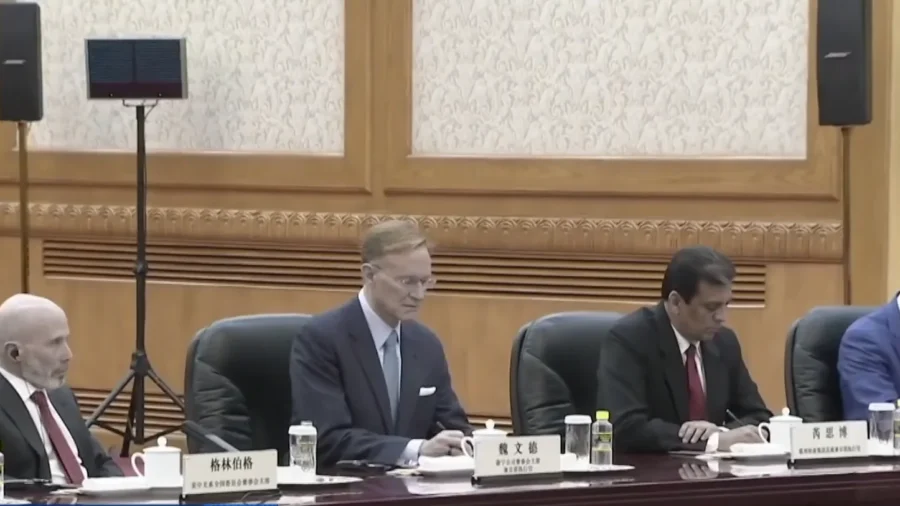
At a meeting hall on the western edge of Tiananmen Square, Xi met with around 20 U.S. executives and academics, and urged businesses to continue investing in China while insisting that its economy hasn’t peaked.
Among the attendees were CEO of private equity firm Blackstone Stephen Schwarzman, head of American delivery giant FedEx Raj Subramaniam, president of chips manufacturer Qualcomm Cristiano Amon, CEO of insurer Chubb Evan Greenberg, founding dean of Harvard’s John F. Kennedy School of Government and former assistant secretary of defense under the Clinton administration Graham Allison, and chairman of Brookfield Asset Management and Bloomberg Inc. Mark Carney.
Clips and readouts released by China’s state media showed a smiling Xi telling participants that China’s growth prospects under the Chinese Communist Party (CCP) are “bright” as the U.S. delegates attentively took notes.
The meeting, organized by multiple pro-Beijing U.S. groups upon the close of the annual China Development Forum, came after a year of a worsening economy and a significant flight of foreign funds. Anti-espionage laws, exit bans, raids on U.S. firms, and U.S.-China tensions have only fueled investors’ anxieties.
Xi, in his New Year’s Eve speech, made a rare acknowledgement about the country’s economic woes, including struggling businesses and job seekers’ troubles to find work. In an address in early March to China’s ceremonial legislature, Premier Li Qiang said that the “foundation for a sustained economic recovery is not solid enough,” pointing to tight local government budgets, weak technological innovation, outside uncertainties, and “many risks and hidden dangers.”
The premier didn’t host a panel session at the end of the forum on March 25, breaking an over 20-year tradition. An expected annual press conference following the parliamentary meeting also got scrapped without explanation.
Xi’s meeting with U.S. executives also followed the conclusion of the annual China Development Forum that saw around 100 world leaders, including heads of the International Monetary Fund and World Bank, at the Chinese capital. Chinese state media noted that a third of them were from the United States.
The CCP authorities have stepped up their push to attract more foreign investment in recent months. The State Council in mid-March issued a measure promising perks for foreign investors on housing, language training, and their children’s education.
Some China analysts are skeptical about the sincerity of Beijing’s efforts.
“You can’t just listen to what he says,” Ding Shuh-fan, professor emeritus at Taiwan’s National Chengchi University, told The Epoch Times. “You watch what they do.”
Feng Chongyi, an associate professor in China studies at the University of Technology, cautioned that the general trajectory of global sentiment isn’t going in the CCP’s favor.
The business leaders follow the money, and the costs and risks in the CCP’s Chinese market are both too great to make them stay, he said.
“[They] keep telling us to invest in China,” he told The Epoch Times of Beijing. “But we have to see if there’s a system in place to back up their assurances.”
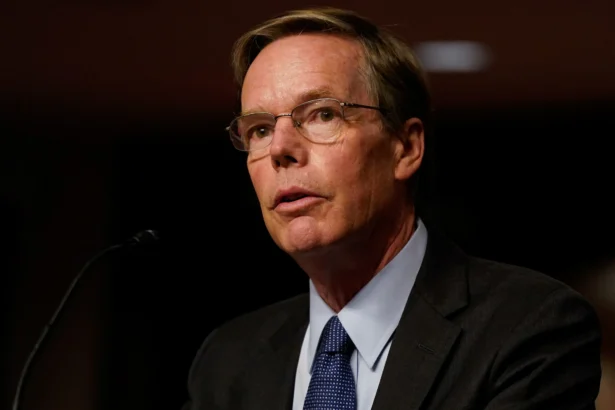
U.S. ambassador to China Nicholas Burns expressed a similar view to Mr. Lai recently.
More respondents said they consider China less welcoming to businesses, and one third of 343 respondents said they were treated unfairly compared to their Chinese counterparts.
Judging by the CCP’s current economic and regulatory conditions, Mr. Lai said that leaving China seems more “mainstream.”
In China, “politics dominates everything” and the economy has become secondary, he said. “So how do they hope to improve the Chinese economy?”