


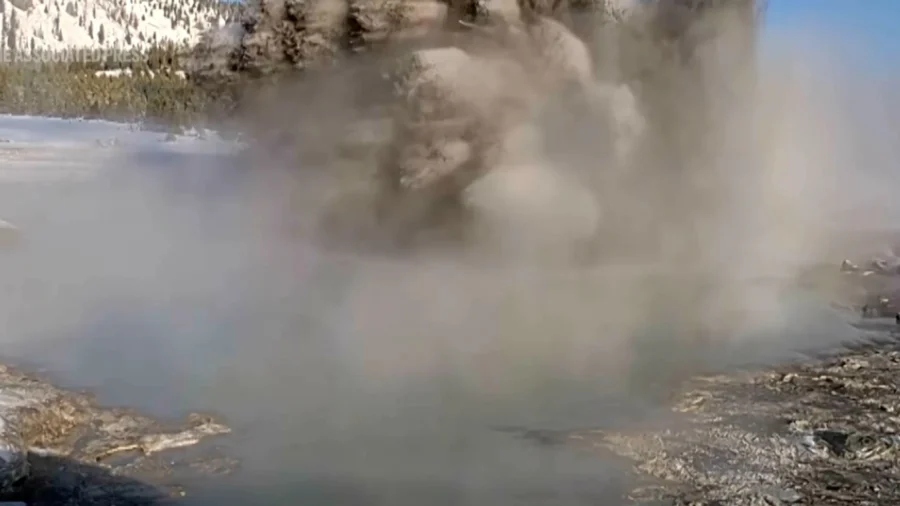
A powerful muddy eruption at Yellowstone National Park's Black Diamond Pool shot debris high into the air Saturday morning, reminding scientists and observers of the volatile hydrothermal activity that continues at the site.
The blast represents the latest in a series of so-called dirty eruptions that have occurred sporadically at Black Diamond Pool over the past 19 months, reaching heights of up to 40 feet. Researchers said that many of such recent events happened at night or when the cameras were blocked by ice, making them audible but not visible.
"We got a nice clear view of one of these dirty eruptions under bright blue skies with the surroundings covered in snow," USGS Volcanoes stated in a post on X.
"A localized hydrothermal explosion occurred near Sapphire Pool in Biscuit Basin, located just north of Old Faithful," park officials said in a news release following the July 2024 incident. Video from that explosion showed a dark plume of steam erupting skyward as visitors fled along the wooden walkway.
The July explosion forced officials to close Biscuit Basin to visitors due to extensive damage and concerns about additional dangerous activity. The area has remained off-limits since then.
Following the event, researchers installed new monitoring equipment this summer to better track activity at the unpredictable site. A camera and seismic and acoustic monitoring station now work alongside temperature sensors maintained by the Yellowstone National Park Geology Program to detect and analyze eruptions as they occur.
The enhanced monitoring proved its worth Saturday when the Yellowstone Volcano Observatory webcam captured clear footage of the muddy blast.
Scientists say the eruptions at Black Diamond Pool follow no predictable pattern and occur without warning signs. The explosions result from water rapidly converting to steam underground within Yellowstone's vast network of hydrothermal plumbing.
Such explosions are relatively common at Yellowstone, occurring at least once annually somewhere in the park. Many happen in remote backcountry areas where they go unnoticed.
Yellowstone contains the world's most remarkable collection of geothermal features, with more than 10,000 hydrothermal sites throughout the park, including over 500 geysers.