


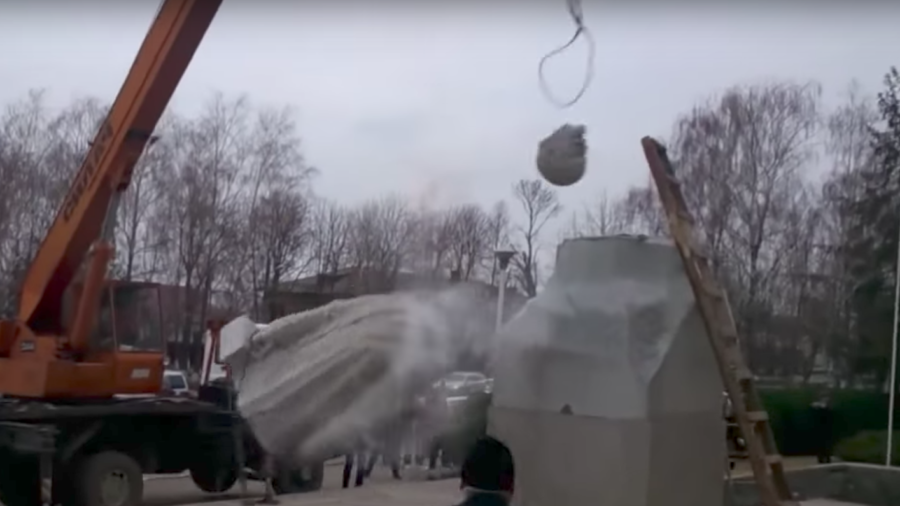
Ukraine has removed all 1,320 statues of Vladimir Lenin, the first Soviet dictator, following a government campaign to remove its Soviet-era symbols.
Another 1,069 Soviet-era monuments have also been removed, said Volodymyr Viatrovych, director of the Institute of National Remembrance.
"Lenin is no more in cities in Ukrainian-controlled territory," Vyatrovych said.
The toppling of the Lenin statues began when protesters took down a monument in Kiev during the Euromaidan demonstrations in 2014. Later, a 2015 law banned communist and Nazi symbols.
Some historians have noted that Lenin's policies helped trigger the Povolzhye famine, which started in 1921 and ran until 1922, leaving millions dead and even more affected.
Some 5 million died in the Povolzhye famine.
Aid workers who arrived from the United States and Europe in 1921 during the height of the famine noted "ghastly rumours about sausages prepared with human corpses, though officially contradicted, were common. In the market, among rough huckstresses swearing at each other, one heard threats to make sausages of a person."
At the time, according to historical accounts, Lenin instructed guards to take food from the poor. His Bolsheviks believed peasants were trying to undermine the war effort by taking their food away from the army.
"Thousands of villages were abandoned by their wretched inhabitants, who went scavenging for food wherever they could hope to find it. They survived on grass, clumps of earth, domestic animals… and even human flesh. In June 1921 Lenin acknowledged the looming tragedy, and the writer [Maxim] Gorki appealed to the world for help. The leadership of the Soviet Red Cross sent a message to Geneva underlining the urgency of the situation."
Another said, "Families were killing and devouring fathers, grandfathers and children."
Lenin died in 1924 shortly after the famine, leaving Joseph Stalin to head the communist party.
In 1922, five years after the Bolshevik Revolution in Russia, Lenin exiled numerous academics, journalists, professors, students, philosophers, and other intellectuals via so-called "Philosophers' Ships."
If they returned, Lenin charged, they would be shot.