


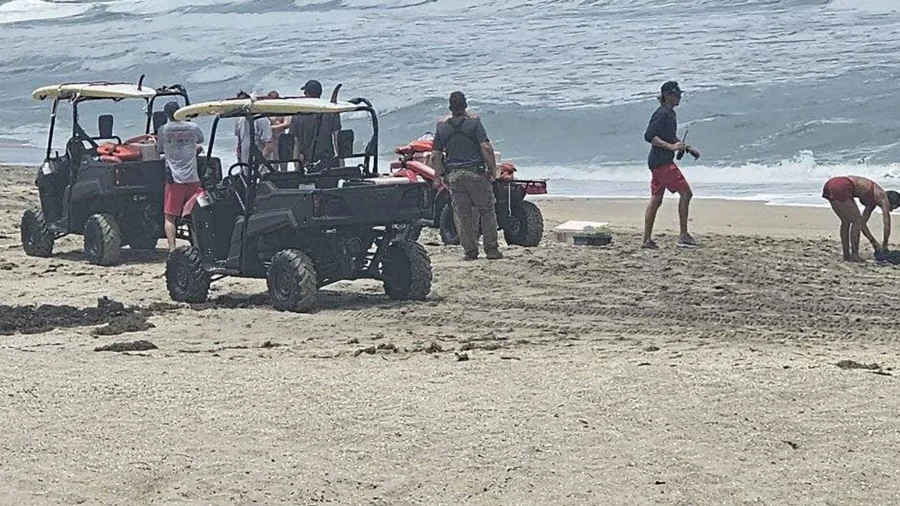
A man from Connecticut and a woman from Ohio died Monday afternoon after being pulled under by a rip current off Cocoa Beach, Florida, authorities said. A tragedy that a fire official warned could happen to even the strongest swimmers.
The two victims—a 42-year-old male from Connecticut and a 34-year-old female from Ohio—were taken to Cape Canaveral Hospital. Both were later pronounced dead.
Preliminary information indicates the incident was caused by a rip current.
"Our team is reactive," Grimes said. "So that means when we get the call, we're responding out there—there's someone already in a rip and someone possibly already drowning. So our goal is to stop that from happening. The best rescue is the one we don't have to do."
Grimes said swimming near a lifeguard is the single most effective safety measure beachgoers can take, noting that lifeguards can intervene before a situation becomes life-threatening—something fire crews cannot do.
"Lifeguards can do something that we can't do, and that's preventative lifeguarding," he said. "They can see when rips are occurring ... they'll be able to watch you at all times and be able to intervene, and if need be, they'll go in and get you out before you get into a really bad situation."
Grimes explained that rip currents form when sandbars erode, creating a channel that funnels water back out to sea—sometimes at alarming speeds.
"Rip currents can make water move five to eight miles per hour," Grimes said. "It doesn't sound like a lot, but the density of water is so much more than air—it's like equivalent to walking through a hurricane. So even the strongest swimmers can be overtaken by rip currents."
One particular danger, he said, is that calmer-looking surf can be the most deceptive. "When we have really big waves day after day after day, and it creates these sandbars, and then the water gets nice and calm—everyone thinks it looks inviting," Grimes said. "That's a lot of times when the rip currents occur."
For anyone caught in a rip current, Grimes stressed that panic is often deadlier than the current itself. He advised swimmers to stay calm, swim parallel to shore, and signal for help.
"It's usually not rip currents that kill people," he said. "It's usually the panic and it's usually the exhaustion that kills people."
If escaping the current by swimming sideways proves impossible, Grimes said swimmers should allow the current to carry them out until it dissipates, then swim back to shore.
For bystanders on the beach who witness someone in distress, Grimes said calling 911 with a precise location is critical. He also cautioned non-swimmers against attempting a rescue themselves, noting that untrained bystanders frequently become victims.
Grimes urged all beachgoers to check ocean conditions and advisories before entering the water, understand what colored flag warnings mean, and stay no deeper than waist-high when conditions are uncertain.
"The Cocoa Beach Fire Department extends its deepest condolences to the victims' families and loved ones," the department said in its press release, "and our thoughts remain with everyone affected by this tragic event."