


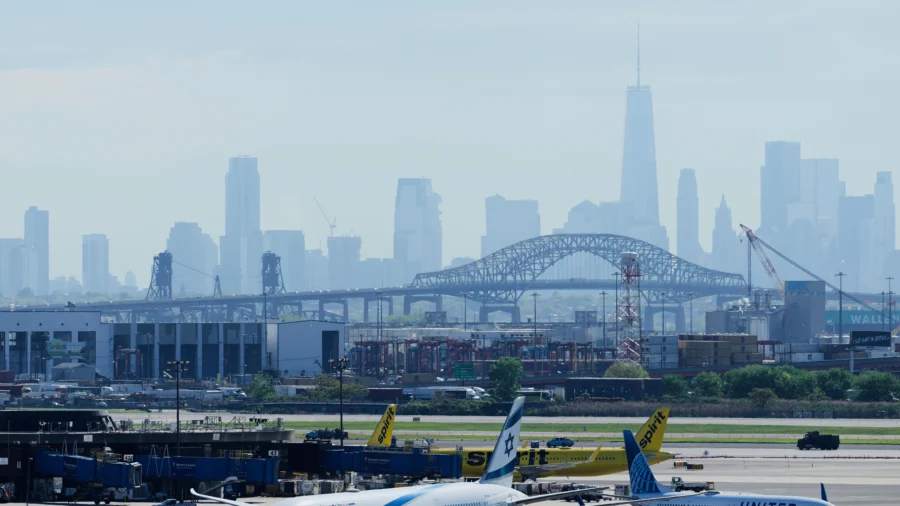
An Alaska Airlines Boeing 737 and a FedEx Boeing 777 cargo jet came dangerously close to colliding while trying to land at Newark Liberty International Airport on Tuesday night, according to the Federal Aviation Administration (FAA) and radar data from Flightradar24.
The FAA said an air traffic controller ordered the Alaska Airlines flight to go around because the FedEx plane had already been cleared to land on an intersecting runway.
Radar data reveals the Alaska Airlines flight, arriving from Portland, Oregon, was just 150 feet off the ground when controllers ordered the go-around, according to the data and air traffic control audio. The FedEx plane, inbound from Memphis, Tennessee, did not abort—it continued its descent and touched down on the crossing runway. The two plane’s arrived at Newark within roughly two minutes of each other, with the incident unfolding around 8:17 p.m.
Both carriers released statements on Thursday afternoon.
"Following instructions from air traffic control, the flight crew of FedEx flight 721 landed safely without incident at Newark Liberty International Airport Tuesday," FedEx said in a statement to numerous outlets. "Please direct further questions to the FAA."
Alaska Airlines acknowledged that its crew had been trained for exactly this kind of scenario. "On Tuesday, March 17, Alaska Airlines Flight 294 was cleared to land at Newark Liberty International Airport," the airline said in its own statement to media outlets. "Air traffic control issued a go around to our aircraft, which our pilots are highly trained for. We're aware the FAA and NTSB are investigating, and any further information would come from those agencies."
Earlier this month, a United Airlines flight bound for Jacksonville, Florida, was forced back to Newark following a bird strike that left the crew reporting a cracked windshield and possible pressurization concerns—though a subsequent inspection found no structural damage, according to a United Airlines spokesperson.
Tuesday's near-collision also comes against the backdrop of the partial government shutdown, which has triggered staffing shortages at the Transportation Security Administration (TSA) and contributed to longer security wait times at airports across the country.
Federal investigators from both the FAA and the National Transportation Safety Board are now examining what led the two commercial aircraft to converge on crossing runways in the dark. The probe will likely focus on air traffic control sequencing and runway assignment procedures at one of the busiest airports in the northeastern United States.