


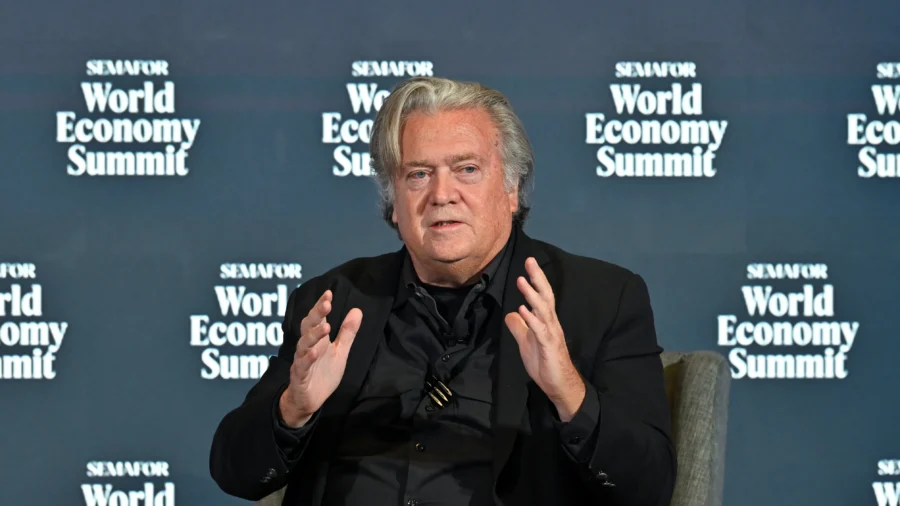
Washington’s federal appeals court on May 27 turned down a request from former White House official Steve Bannon, in a split decision that could end up at the Supreme Court.
“Licavoli’s holding stems from the Supreme Court’s earlier opinion in United States v. Helen Bryan,” a ruling from 1950, Garcia wrote. “Thus, if there are any doubts about the proper interpretation of ‘willful’ in this statute, they are for the Supreme Court to resolve.”
Garcia, whose concurring opinion was joined by Circuit Judges Cornelia Pillard, Robert Wilkins, and Florence Pan, said that he believes both Licavoli and Bryan were correctly decided.
Circuit Judge Gregory Katsas said in a statement respecting the denial of the petition for rehearing en banc that there may be issues with the court precedent, but “any problematic overbreadth is something that only the Supreme Court can fix.”
Circuit Judge Neomi Rao, in a dissent joined by Circuit Judges Karen LeCraft Henderson and Justin Walker, said that Bannon’s request raised important issues.
The law for contempt “requires proof the defendant ‘willfully’ defaulted on a congressional subpoena. But over sixty years ago, this court read the willfulness requirement out of the statute,” she wrote. “The full court should overturn Licavoli because it is at odds with the plain meaning of section 192 and longstanding Supreme Court precedent interpreting willfulness in criminal statutes.”
Bannon has also presented evidence that the House panel may not have been composed in a way that gives it authority to issue legal subpoenas, according to the dissent. The authorizing resolution for the panel required 13 members and a ranking member to be appointed, neither of which happened.
A lawyer representing Bannon did not return a request for comment by publication time.