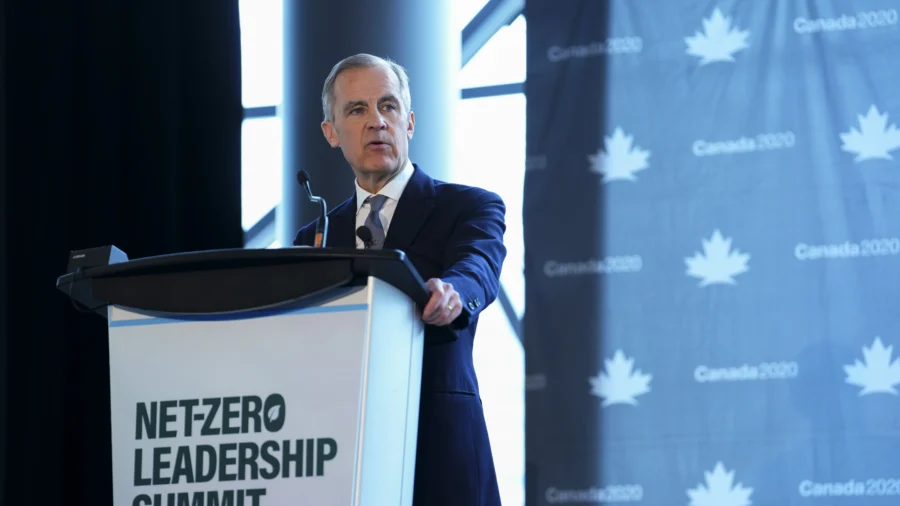
A net-zero club for banks is the latest global climate alliance to halt operations after mass departures of its members, but analysts say the departures could be more about avoiding legal action than a fundamental change of heart.
On Aug. 27, having experienced a loss of members—including all six of America’s largest banks—the Net Zero Banking Alliance (NZBA)
recommended to the banks that remained that the organization transition from a “membership-based alliance” to a “framework initiative.”
The NZBA said this would entail supporting banks “to remain resilient and accelerate the real economy transition in line with the Paris Agreement.”
The organization polled remaining members for their views and said it would publicize the results at the end of September. Until then, it is putting its operations on hold.
Critics of the NZBA saw this action as a positive step, with caveats.
“It’s encouraging to see these alliances unravel, but I wouldn’t call it a victory,” Utah Treasurer Marlo Oaks, a frequent critic of the net-zero alliances, told The Epoch Times.
“The underlying agenda hasn’t gone away; it’s simply being repackaged.
“Still, this is a clear sign that public scrutiny works and that the pressure campaign against lawful industries cannot withstand legal, political, and market accountability.”
Climate Alliances Span the Financial Industry
The NZBA is part of the U.N. Environmental Program Finance Initiative (UNEPFI), which includes net-zero alliances for insurance companies (the Net Zero Insurance Alliance) and investors (the Net Zero Asset Owners Alliance), coordinated by a Geneva-based secretariat with a mission to “shape the sustainable finance agenda.”Established in 1992, this network included more than 500 banks and insurers with assets of more than $170 trillion.
An October 2024
statement by UNEPFI reads: “When joining NZBA, banks voluntarily commit to independently setting their first targets for reducing emissions associated with their financing activities in carbon-intensive sectors of the economy.”
Other global climate associations include Climate Action 100+, the Net Zero Asset Managers initiative, the Glasgow Financial Alliance for Net Zero, and the Network of Central Banks and Supervisors for Greening the Financial System, which the U.S. Federal Reserve
joined in 2020.
The financial industry has been essential to the net-zero movement because it has provided powerful leverage over the wider economy. Companies were not only dependent on alliance members for financing and insurance, but these financial giants are also often companies’ largest shareholders.
A 2017
study by Pensions & Investments, an analytics group, found that institutional investors owned about 78 percent of the market value of the Russell 3000 index and 80 percent of the large-cap S&P500 companies.
But, while proponents of the net-zero alliances say that issues related to the climate are so dire that CO2 emissions must be cut by any means necessary, critics say the alliances threaten to drive up energy costs without tangible benefit for the environment.
“Americans want affordable, reliable energy, not elitist policies that raise costs, kill jobs, and weaken national security,” Jason Isaac, CEO of the American Energy Institute, told The Epoch Times.
“Net zero is a foreign-born political agenda being forced on U.S. families by unelected bureaucrats and financial elites, and the public is waking up to it.”
‘A Giant Leap Backward’ for Banks, Says Net-Zero Advocate
Since the start of President Donald Trump’s second term and the White House’s emphasis on increasing America’s oil and gas production, financial firms have been stepping away from climate alliances. In April, Lucie Pinson, director of Reclaim Finance, an advocate for net-zero alliances,
berated members of the NZBA for watering down their commitments from “mandatory requirements” to “guidance,” calling it “a giant leap backward.”
Since then, major U.S. and European banks, including Goldman Sachs, Wells Fargo, Citibank, Bank of America, JPMorgan Chase, Morgan Stanley, UBS, HSBC, and Barclays, went a step further and
quit the NZBA altogether.
The Net Zero Asset Managers initiative
suspended its activities in January after several of its largest members, including BlackRock, left the group.
In 2023, half the
members of the Net Zero Insurance Alliance, including Munich Re, Zurich Insurance Group, and Hannover Re, quit the group.
Munich Re
cited “material antitrust risks” among its reasons for quitting.
The alliances have faced increasing scrutiny from
financial officers and
attorneys general and warnings that they could be violating antitrust laws and their fiduciary obligations to investors by putting ideological goals over shareholder returns.
“These exits aren’t acts of principle, they’re acts of self-preservation,” Isaac said.
“They’re pulling out to dodge public scrutiny and legal risk, not because they’ve had a change of heart.”
Change of Heart or Rebranding?
Analysts say the commitments to net-zero may survive the dissolution of the alliances, though members may be less vocal about it. “What they’re basically doing is rebranding and trying to figure out how they can go about advancing their leftist agenda without attracting the attention of red states and the Trump administration,” Steve Milloy, senior fellow at the Energy and Environment Legal Institute and a longtime critic of corporate activism, told The Epoch Times.
Recent data, however, suggest that whatever antipathy banks may have had toward fossil fuels is waning.
In June, Reclaim Finance
reported that bank financing for fossil fuel projects, which had been declining since 2021, is now on the rise again, with U.S. banks leading the way.
In 2024, banks worldwide provided $429 billion in fossil fuel financing, an increase of about $85 billion over the previous year, with JPMorgan Chase, Bank of America, Citigroup, and Wells Fargo providing 21 percent of the global total, the organization stated.
In 2023, JPMorgan Chase CEO Jamie Dimon voiced
support for the oil and gas industry, stating in a CNBC interview that abandoning fossil fuels would be a “calamity” and spark a “global depression.”
“We need oil and gas. We need cheaper oil for 50 years. It’s 100 million barrels a day that are used by the world to heat, fuel, feed people,” he said.
Costs and Benefits of Net-Zero
Europe has led the
world in transitioning to wind and solar energy, and electric vehicles, in an attempt to comply with the Paris
Agreement.
According to a report by the European Commission (EC), “renewable energy” accounted for 50 percent of the EU’s electricity production in 2023.
However, the cost of electricity is substantially higher in Europe than in the United States, with the average consumer paying 26.6 cents per kilowatt hour in the EU in 2023, compared to 16 cents in America,
according to the Energy Policy Research Foundation.
For all that, Europe’s efforts to cut CO2 emissions are largely being overwhelmed by developments elsewhere.
Germany, for example, is responsible for 1 percent of the world’s coal production and cut its production by 10 percent in 2024 to 92 million tons, according to a
study by Visual Capitalist, an analytics firm.
China, by contrast, is responsible for 51 percent of the world’s coal production, and increased its production by 1 percent to 4.8 billion tons that year.
India and Indonesia, the second and third largest producers, accounted for about 12 percent and 9 percent of the global total, respectively, and both increased their coal production by about 7 percent last year.
In addition to questioning the benefits of net-zero policies, critics also say they deprive Americans of having a say in the country’s energy production, both as voters and consumers.
“One of the objectives of these alliances has been to reshape our economic system by distorting how capital is allocated, steering it away from critical industries not because of risk or return, but to achieve political goals,” Oaks said.
“At the same time, they’ve sought to take decision-making out of the hands of voters by setting public policy through private financial clubs.
“The fracturing of these alliances is a reminder that policy must be set through democratic debate, not dictated by global financial coalitions.”
The Epoch Times reached out to the Net Zero Banking Alliance for comment, but did not receive a response by publication time.