

As Gas Prices Rise, 3 Things to Know Before Buying an EV

Consider these key financial and lifestyle factors that come into play once you take ownership of a new or used EV.
Published: 5/18/2026, 10:13:21 AM EDT
As Gas Prices Rise, 3 Things to Know Before Buying an EV
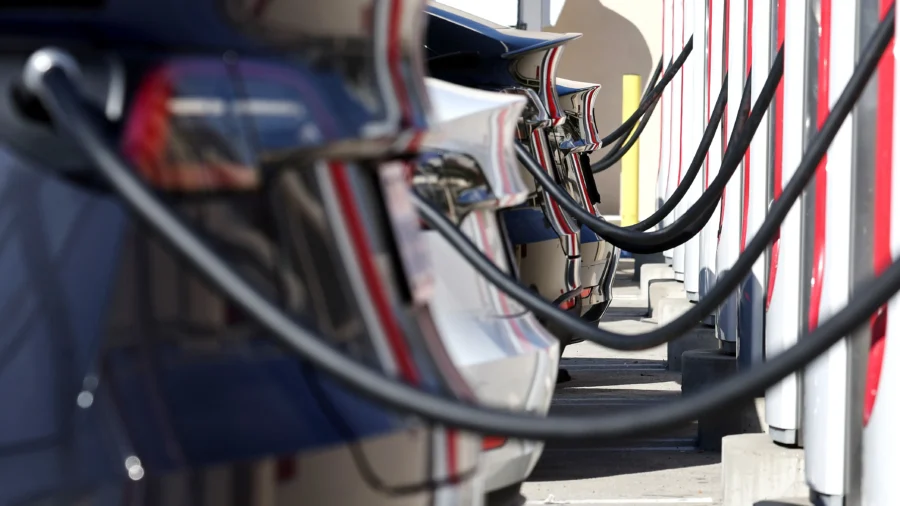
Tesla electric cars recharge at a Tesla Supercharger station in Burbank, Calif., on Jan.16, 2024. (Mario Tama/Getty Images)
U.S. gasoline prices are working consumers’ last nerve, with no relief in sight. On a year-to-year basis, gas prices are up from $3.18 per gallon in May 2025, to $4.53 per gallon in May 2026, according to AAA.

“After five straight days of declines earlier this week, the national average is once again on its way back up,” AAA reported in its most recent survey.

The association doesn’t expect prices to slide downward anytime soon.

“Today’s national average is a couple of cents lower than last week, but with crude oil prices hovering in the $100/barrel range, pump prices remain elevated,” the report noted. "Travelers are preparing to hit the road in record numbers, and drivers will be facing the highest Memorial Day gas prices in four years.”

A New Opening For Electric Vehicles

With gasoline prices leaving Americans fuming, some consumers are pivoting to electric vehicles (EVs), even if that interest may be at the tire-kicking stage.
According to J.D. Power’s 2026 U.S. Electric Vehicle Consideration Study, released May 14, the recent surge in gas prices has helped boost interest in EVs. In April, 26 percent of new-vehicle shoppers said they were “very likely” to consider purchasing an EV, which is up 3 percentage points from the previous month, JD Power reported.
At the same time, the report noted the share of car buyers who said they’re “very unlikely” to consider an EV dropped 4 percentage points month-over-month to 18 percent in April. The increase in interest helped drive the overall percentage of new-vehicle shoppers who say they are “very likely” to consider an EV to 25 percent in 2026 (up 1 percentage point year-over-year), while 35 percent are “somewhat likely,” unchanged from a year ago.

3 Things to Know Before Buying An EV in 2026

While rising gas prices may be driving more buyers toward EV lots this spring, don’t head there without doing your homework first. Consider these key financial and lifestyle factors that come into play once you take ownership of a new or used EV.

Potential charging headaches

According to the J.D. Power report, charging realities remain the top concern for EV buyers.

“Overall, charging station availability remains the leading reason for EV rejection among shoppers this year, though it has declined 6 percent year over year to 46 percent,” the report stated. “Charging time, the second-most common concern, has also improved, falling 2 percentage points year over year to 44 percent.”

Where you live and drive should also carry extra weight when purchasing an EV, and that’s why potential buyers check whether their local infrastructure can support EVs.

"For instance, the number of Level 3 chargers in the U.S. increased by 30 percent in 2025, but distribution remains uneven, so some cities are much better suited to EV ownership than others," Maya Afilalo, an analyst at AutoInsurance, told NTD.
Afilalo recently researched and ranked American cities by EV-friendliness, based on the number of level 2 and 3 chargers, average charging costs, and the availability of EV-related tax incentives. Here are her top ten picks for cities and EV charging stations.
  • Boston, MA
  • Los Angeles, CA
  • San Diego, CA
  • Seattle, WA
  • Atlanta, GA
  • San Francisco/San Jose, CA
  • Sacramento, CA
  • Austin, TX
  • Denver, CO
  • Kansas City, MO
On the flip side, New York, Chicago, and Philadelphia all have surprisingly few chargers relative to their populations. “Consequently, buyers in these locations should be aware that there may be high competition for public chargers,” Afilalo noted.

Watch Out for Faster Vehicle Value Depreciation

Another issue EV buyers should understand is just how quickly EVs currently depreciate compared to the broader market.

“Based on our latest internal data, a one-year-old EV with roughly 10,500 miles is selling for an average of 42 percent below its original MSRP,” Michael Wu, founder at Carflock, an AI chat agent that helps consumers negotiate vehicle pricing with dealers, told NTD News.

“That creates both a risk and an opportunity. The risk is taking a large depreciation hit when buying new. The opportunity is that slightly used EVs can offer tremendous value for buyers willing to shop the used market.”

Negotiate Aggressively

EB buyers should take their time, shop with multiple dealers, and compare new and slightly used EVs side by side.

“New EVs are already heavily discounted, but the data shows that pricing can vary more from dealer to dealer than almost any other vehicle segment right now, creating significant negotiation opportunities,” Wu said.

For example, the largest discount Wu has seen is on a new Equinox EV, which was 38.3 percent off MSRP, bringing its price close to that of a one-year-old used model.

“While the price gap can be substantial, aggressive dealer discounts can narrow it considerably,” Wu noted. “In some cases, simply telling a dealer you're open to a lightly used alternative, especially if a competitor has one that better fits your preferences an give you additional leverage and lead to deeper discounts on a new EV.”

Don’t Make This EV Buying Mistake

One big EV-buying no-no is treating the buying experience the same way you’d buy a traditional gas vehicle. “EV buyers should look beyond year, mileage, and price,” Vincent Prevost, the CMO of Vision Marine Technologies, told NTD News.

“Battery health, remaining warranty, charging compatibility, software updates, service history, and real-world range all matter.”

For used EVs, battery condition is especially important. “Buyers should understand the warranty, ask for available battery diagnostics, and make sure the range fits their daily routine,” Prevost said.

The views and opinions expressed are those of the interviewees. They are meant for general informational purposes only and should not be construed or interpreted as a recommendation or solicitation. NTD does not provide investment, tax, legal, financial planning, estate planning, or any other personal finance advice. NTD holds no liability for the accuracy or timeliness of the information provided.