


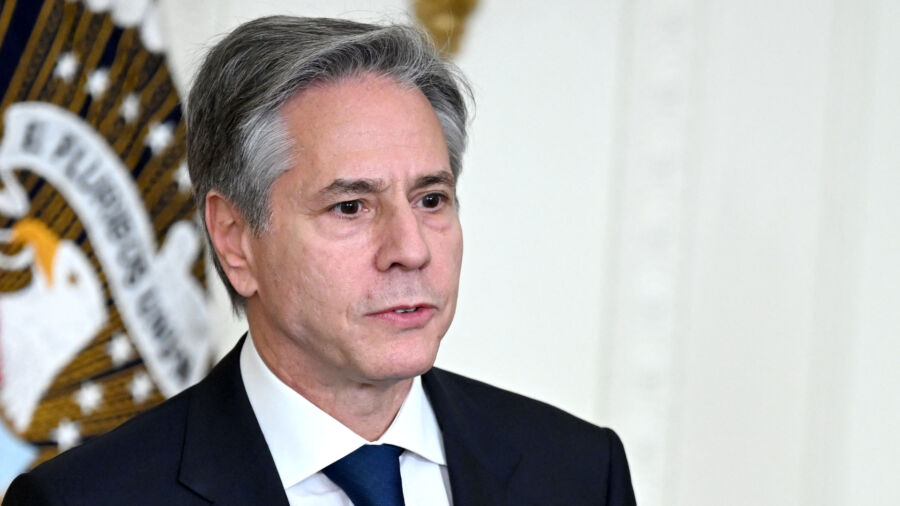
WASHINGTON—Secretary of State Antony Blinken is traveling to China this week to meet with Chinese communist leadership, the State Department has acknowledged.
The visit is part of a larger effort by the administration to erect guardrails around the two powers’ increasingly bitter competition, State Department spokesperson Matthew Miller said.
“Intense competition requires intense and tough diplomacy to ensure that competition does not veer into confrontation or conflict, and that’s what we intend for this visit,” Miller said during a June 14 press briefing.
US Seeks to Manage China Competition Without Conflict
The visit to China is Blinken’s first in his role as the United States’ top diplomat, as well as the first time a secretary of state has gone to Beijing since 2018.Since then, the Biden administration has repeatedly stated that the trip would still take place as part of its wider effort to engage with the Chinese Communist Party (CCP).
“We thought it was important that there be a direct channel of communication between our two countries,” Miller said.
“Obviously, we have a competitive relationship with China … but it’s important as two of the world’s great powers that we have the ability to directly communicate with each other so that competition doesn’t veer into conflict.”
The CCP, which rules China as a single-party state, has systematically sought to cut or reduce communications with the United States over the last year and a half.
That communications blackout has mostly affected military-to-military communications, which U.S. leadership says are vital to managing Sino-American competition peacefully and without catastrophic miscommunication.
US Acknowledges Engagement Will Not Change CCP
Though the Biden administration continues a meaningful dialogue with the CCP, officials have hinted that there is an understanding that traditional engagement with the regime has failed, and new approaches will be needed to manage the relationship effectively.Put simply, the administration now acknowledges that economic and diplomatic engagement with the CCP will not reform the regime, said National Security Council Coordinator for Indo-Pacific Affairs Kurt Campbell during a June 14 press call.
“We’re clear-eyed about [China],” Campbell said. “We know efforts to shape or reform China over several decades have failed. And we expect China to be around and to be a major player on the world stage for the rest of our lifetimes.
“We are in competition with China, but we do not seek conflict, confrontation, or a new Cold War. We are for managing the competition responsibly.”
Campbell added that the United States would “push back” against CCP attempts to provoke a crisis in the Taiwan Strait or elsewhere, but that open communications between the two nations were still vital to prevent unnecessary escalations.
“Intense competition requires intense diplomacy if we’re going to manage tensions,” Campbell said. “That is the only way to clear up misperceptions, to signal, to communicate, and to work together where and when our interests align.
“We have an interest in setting up crisis communication mechanisms to reduce conflict risk.”
Not all agree with the administration’s dedication to increasing engagement with the CCP.
Critics of the trip have portrayed the visit as a kowtow to an increasingly authoritarian regime that has shown no signs of liberalizing after decades of engagement.
China Continues War Preparations
Blinken’s trip to China comes amid increased efforts by the CCP to prepare its military and population for conflict.These include new aircraft carriers, space and counterspace capabilities, and the largest nuclear expansion since the Cold War.
Slowing that proliferation is thus a key area of concern for the Biden administration.
“Today, we now stand at what our president would call an ‘inflection point’ in our nuclear stability and security.”
When asked by The Epoch Times whether Blinken would broach the topic of nonproliferation during his visit, the State Department’s Matthew Miller said the administration would not telegraph its specific talking points ahead of time.
“I’m not going to read out the specific comments that we expect to raise in the meetings before we have them, other than to say that we have a number of issues of concern, we have issues on which we think that we can cooperate, and we will raise a wide range of topics with the Chinese officials,” Miller said.
Asked if the Biden administration considered nuclear proliferation an arena where the United States and the CCP might cooperate, Miller declined to comment.