


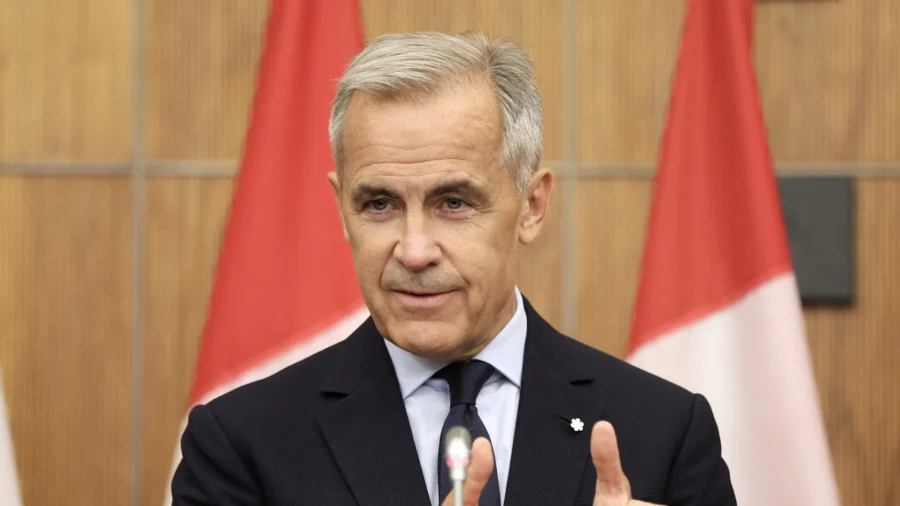
Prime Minister Mark Carney announced that Canada will remove some retaliatory tariffs on the United States as a goodwill gesture designed to resume stalled trade talks. The announcement came one day after Carney and U.S. President Donald Trump spoke on the phone.
Canada will remove tariffs on goods from the United States that are covered by the United States-Mexico-Canada Agreement (USMCA) by Sept. 1, Prime Minister Mark Carney said at an Aug. 22 press conference.
The prime minister said Canadian tariffs on U.S. automotives, steel, and aluminum will remain for now, as Ottawa works to develop a “new trade and security relationship” with the United States. Washington has imposed global sectoral tariffs on autos, steel, and aluminum, as well as blanket 35 percent tariffs on all Canadian products that are not under the USMCA.
Trump said in the Oval Office later the same day that Ottawa’s removal of counter-tariffs was “nice” and that he and Carney would have another phone call soon. “We are working on something we want to be very good to Canada. I like Carney a lot,” he said.
Canada imposed 25 percent tariffs on a long list of American goods in March, including oranges, alcohol, clothing and shoes, motorcycles, and cosmetics, in response to U.S. tariffs on Canadian products. These reciprocal tariffs included some U.S. goods that are compliant with USMCA, which the U.S. government has criticized.
The United States raised tariffs further on Canada from 25 percent to 35 percent beginning on Aug. 1, citing illicit drugs continuing to flow over the shared border, as well as Canada’s retaliatory measures. Trump had previously said that countries that did not impose retaliatory tariffs on the United States would be “rewarded.”
Carney said that under the U.S. government’s new trade approach, other countries must now “buy access” to its markets. Carney noted that since the United States confirmed that USMCA-compliant goods are not subject to tariffs, over 85 percent of Canada-U.S. trade is tariff-free.
“Canada currently has the best trade deal with the United States. And while it’s different from what we had before, it is still better than that of any other country,” he said.
Carney said that while Canada’s retaliatory tariffs were implemented to protect Canadian workers and “incentivize a negotiated settlement” with the United States, Ottawa needed to do everything it could to “preserve this unique advantage” of lower tariffs relative to other countries. He said this would be done by building on the USMCA and creating a new trade and security partnership with the United States.
Carney added that the process of “steady integration” with the United States was “now over,” and Canada needed to focus on securing new trade deals with other countries while creating new opportunities for Canadian workers.
When asked by reporters if his government was backing down in the face of U.S. pressure, given his key “elbows up” election-time messaging, Carney likened the initial response to Washington to a hockey game where Canada had to “drop the gloves in the first period and send a message.”
“But there’s also a time in a game where you want the puck—you want to stick handle; you want to pass; you want to put the puck in the net. And we’re moving later into the game, we’re at that time in the game,” he said.
Carney also addressed the phone call he had with Trump the previous day, and said the two are attempting to “build on where a relationship already is.” He said there are opportunities for investments in both economies, and the two leaders “intend to advance those discussions as rapidly as possible.”
Conservative Party Leader Pierre Poilievre said the removal of the counter-tariffs marks “yet another capitulation” by the Liberal government.
“[Carney] made concessions on the military while getting nothing in return. He pulled back on his digital services tax—a terrible tax—but you think he’d get something in return for it, nothing. And today, he removed even almost all of the tariffs on the United States and got none lifted from Canada,” Poilievre said at a press conference.
“If the federal government can’t achieve that, they need to hit back hard against U.S. tariffs and provide additional supports for the workers and businesses in these sectors,” he said.
Carney and Trump held a phone call on Aug. 21, the first time they had done so since the trade deal deadline passed. Carney said the two had a “productive and wide-ranging conversation.”
“We focused on trade challenges, opportunities, building a new economic and security relationship between Canada and the U.S., and supporting long-term peace and security for Ukraine and Europe,” he said in a statement.