


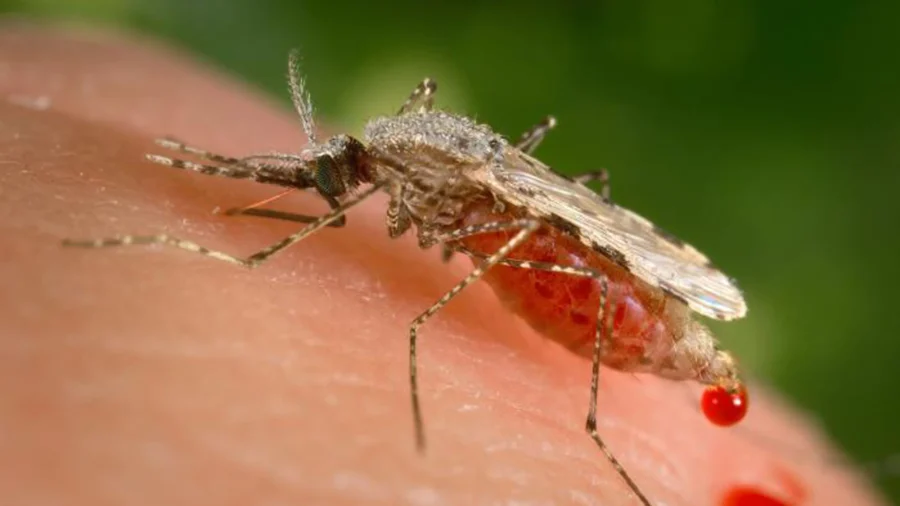
The Centers for Disease Control and Prevention warned Thursday in a new report that malaria, a sometimes fatal blood parasitic disease, could be reestablished in the United States.
Noting that the United States eliminated malaria, which is transmitted through certain types of mosquitoes, in the early 1950s, the CDC stressed that "the country remains susceptible to malaria reintroduction."
The reason, according to the CDC's report, is "the continued importation of malaria cases and the continuous presence of competent mosquito vectors."
"Local mosquitoes capable of transmission could bite someone who acquired malaria parasites outside of the United States and spread it to persons who have not traveled."
About 2,000 cases of malaria and seven deaths, on average, are reported in the United States each year. Most of the cases are diagnosed among people who had returned to the United States from a country that has endemic malaria.
In 2023, 10 cases of locally transmitted malaria were reported across four states: Arkansas, Florida, Maryland, and Texas, according to the CDC.
The agency added that since 1972, the annual number of malaria cases among U.S. civilians has risen, adding that conditions in many parts of the country are suitable for local transmission. That's particularly the case in areas where Anopheles mosquitoes are indigenous, it said.
The CDC report provided new guidance for public health officials on how they could respond to cases of locally transmitted malaria. As a precaution, health agencies and departments should spray insecticides and reduce the breeding habitats of mosquitoes during outbreaks of malaria.
"In contrast to vector-borne diseases that have other animal reservoirs, prompt detection and response efforts for malaria can successfully ensure that control measures directed at humans and mosquitoes effectively limit the spread of focal outbreaks," the CDC said.
The CDC also said that health officials should speak to doctors and other health care workers about reporting any confirmed or suspected malaria cases to health agencies.
People infected with malaria can suffer fever, chills, and headaches that, if left untreated, can lead to severe complications and death. It’s mainly found in tropical and subtropical climates, health officials say.
More severe symptoms can include extreme fatigue, impaired consciousness, convulsions, dark or bloody urine, abnormal bleeding, and jaundice, or the yellowing of the skin and eyes, officials say.
The infection is caused by a mosquito-borne parasite and does not transmit from person to person. Symptoms usually start 10 to 15 days after a person is bitten by an infected mosquito.
Malaria killed around 610,000 people in 2024, mostly young children in sub-Saharan Africa, the World Health Organization said in December 2025. The toll was a slight increase from 2023, and case numbers also went up, from 273 million to an estimated 282 million, according to the World Health Organization’s (WHO) annual malaria report.
WHO added that Africa has "a disproportionately high share of the global malaria burden" and that in 2024, it was home to around 95 percent of all cases and deaths. Half the deaths in the region occurred in Nigeria, the Democratic Republic of Congo, and Niger, it said.