


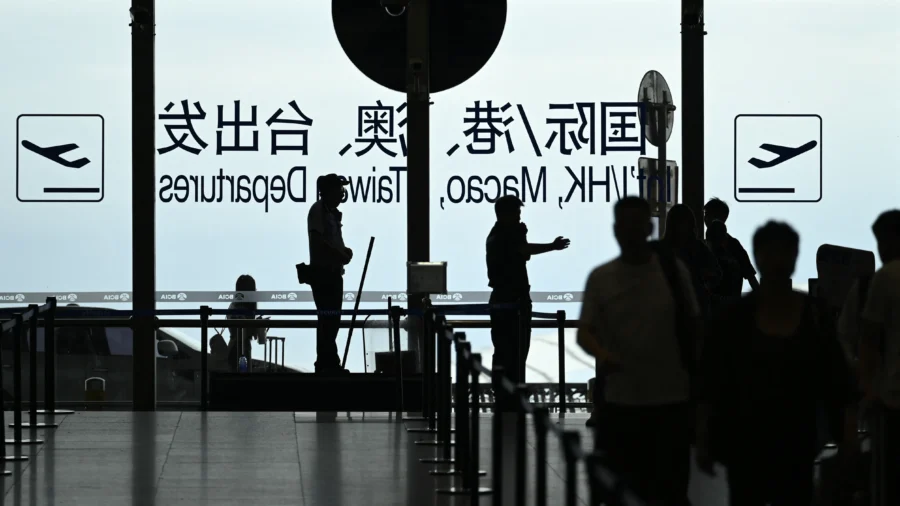
China has issued new regulations on entry and exit management, imposing restrictions ranging from passport applications to outbound and inbound travel.
The regulations consist of 19 articles focusing primarily on four key areas: risk standardization, application requirements, restrictive measures, and intermediary services.
The move is widely seen as a strong signal that the Chinese Communist Party (CCP) is returning to a policy of "seclusion" (closing the country to the outside world).
According to Article 3, authorities may require applicants to present relevant documents, materials, electronic data, and other information to verify the identity and travel purpose of individuals.
'Sealing the Country Off'
Under Article 4, if Chinese citizens engage in "illegal or criminal activities abroad that endanger national security and interests," authorities may decide to bar them from leaving the country for a period ranging from six months to three years.Furthermore, citizens who violate "regulations on export control, technology import and export management, or other rules that may endanger national industrial and technological security" can also be denied exit.
These provisions have sparked widespread criticism and concern, with many believing that China's doors are gradually swinging shut.
"The goal is to keep people inside from knowing what is happening abroad. The regime fears the outbreak of internal risks and dreads losing control of society," You said.
He added that the ultimate purpose is to prevent the flow of people and the spread of truth to mitigate regime risks: "The CCP wants to seal the country off."
No Reason Provided for Exit Bans
Article 6 states that the deciding authority should notify the party concerned in writing of the facts, reasons, and legal grounds for denying exit.However, in circumstances that may affect national security or criminal investigations, authorities may "withhold notifying the individual" of the reasons for the exit ban.
You Feiyu anticipates that "the CCP's policies will likely become even harsher and more repressive, potentially reverting to a Cultural Revolution-style system where society is engulfed in widespread fear. At the same time, expanding scrutiny permissions will encourage power-for-cash transactions among officials, driving up corruption."
Quiet Pre-Implementation Underway
Although the new entry-exit regulations are officially set to take effect on Sept. 15, insiders in the Chinese system told the Chinese edition of The Epoch Times that international airports, land ports, and travel agencies have already begun quietly trial-implementing the rules.The insider, Ge, said that starting Aug. 1, international airports and land border checkpoints across China began testing the new measures.
Targeted inspections primarily focus on travelers heading to Myanmar, Cambodia, Laos, Vietnam, and Thailand. Outbound inspections have also been significantly tightened at land border crossings in Shenzhen and Zhuhai (Guangdong Province), as well as Ruili (Yunnan Province), he said.
"Currently, some people holding foreign passports fall into dual citizenship status, with part of their assets stored overseas. To prevent them from leaving and not returning, they are being barred from joining outbound tour groups," Liu said.