


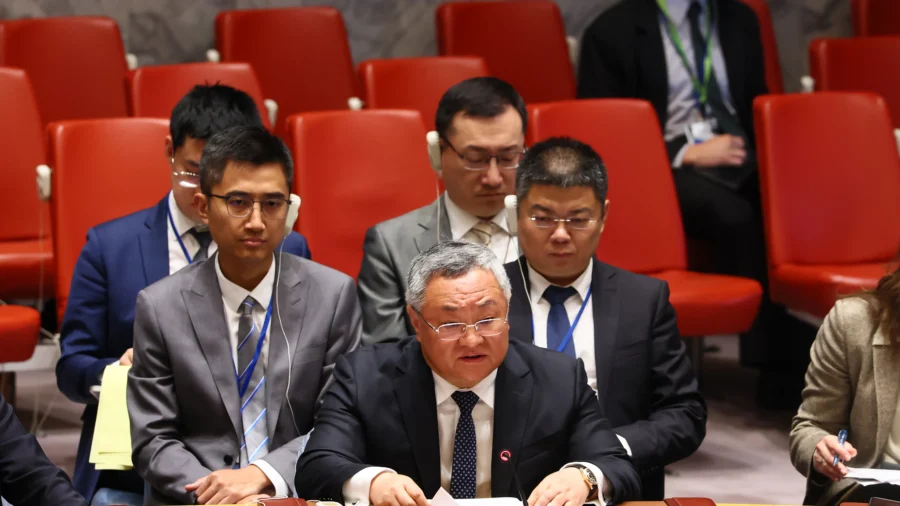
China and Russia used their veto power on April 7 to block a United Nations Security Council resolution to coordinate efforts to protect maritime trade routes along the Strait of Hormuz.
The narrow waterway has come under Iranian attack in recent weeks.
As permanent members of the U.N. Security Council, Russia and China both possess veto power to block measures before the international body.
They both exercised their vetoes on Tuesday.
The proposed resolution was the latest pitch to protect maritime traffic in the Strait of Hormuz, which forms a chokepoint along a major artery for the export of petrochemicals and other global commodities.
Iranian forces began targeting ships in the strait after U.S. and Israeli forces launched attacks on Iran on Feb. 28.
These attacks have damaged several tankers and caused commercial ships to hesitate, slowing overall traffic through the waterway, constraining global fuel supplies, and driving up costs.
Eleven members of the Security Council voted in favor of the U.N. Security Council resolution on Tuesday. Colombia and Pakistan abstained.
Pakistan has acted as a mediator in negotiations between Washington and Tehran.
“Our objective is clear: a permanent end to hostilities, containing the expansion of this conflict and preventing any further loss of civilian life or destruction of critical infrastructure,” Pakistani ambassador Asim Iftikhar Ahmad said following the failed vote on Tuesday.
The U.N. Security Council vote came hours ahead of a deadline, set by U.S. President Donald Trump, for Tehran to accept terms to end the fighting.
Trump has threatened extensive attacks on Iran's energy sector and other critical infrastructure if no deal is reached by 8 p.m. (EST) on April 7.
The resolution before the Security Council had undergone multiple revisions before the vote, in an effort to win over holdouts.
An earlier draft of the resolution, submitted by Bahrain, would have authorized countries to use “all necessary means” to protect the strait.
Subsequent drafts of the proposed resolution called for the authorization of “all defensive means necessary" to protect traffic in the waterway, and limited the authorization to the Strait of Hormuz rather than adjoining waterways like the Persian Gulf and Gulf of Oman.
Bahrain's Foreign Minister Abdullatif bin Rashid Al Zayani said the outcome of the Tuesday vote sends a signal "that threats to international waterways can pass without any decisive action by the international community."
U.S. Ambassador to the U.N. Mike Waltz joined in the condemnation, saying Beijing and Moscow have "sided with a regime that seeks to intimidate the Gulf into submission, even as it brutalizes its own people during a national internet blackout for daring to imagine dignity or freedom."
Waltz also called on the international community to join the United States in working to secure the Strait of Hormuz.
U.S. forces have already reported damaging or destroying more than 155 Iranian naval vessels, including dozens of minelaying ships that could be used to obstruct the strait.
Explaining their "no" votes, Beijing and Moscow's representatives at the U.N. both said the resolution Bahrain had submitted did not address the root causes of the current standoff in the Strait of Hormuz.
They both blamed the standoff on what they described as illegal attacks by the United States and Israel on Iran.
The Trump administration has said that the military operation against Iran was a preemptive attack to prevent a terrorism-backing regime from obtaining a nuclear weapon.
Iranian Ambassador to the U.N. Amir-Saeid Iravani said Iran's attacks in the Strait of Hormuz have targeted ships associated with countries that have been aggressive toward Tehran, and its allies and partners.