


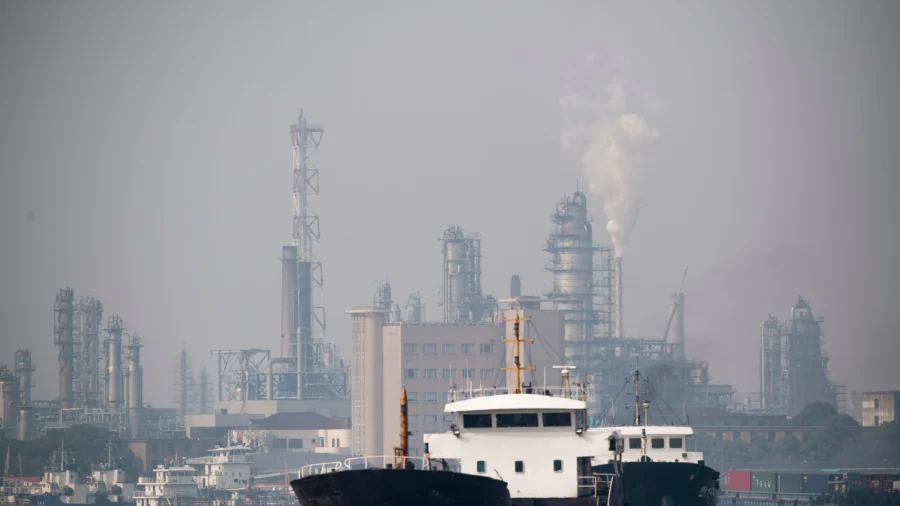
The Chinese Communist Party (CCP) is slashing exports of oil products and other materials in what insiders describe as akin to “wartime measures” and potentially providing indirect support to Iran.
A source in China’s foreign trade sector familiar with import-export policy told the Chinese-language edition of The Epoch Times on March 6, using the pseudonym Huang Juguang out of fear of reprisal, that amid rising tensions in the Middle East, Beijing has ordered relevant domestic enterprises to tighten export controls on strategic materials, including tactical drones, rare earth minerals, and refined petroleum products.
According to Huang, some technology companies and trading firms have already received verbal notices requiring additional reviews of export contracts and stricter approval procedures for the ones involving “sensitive regions.”
The directives come as joint U.S. and Israeli strikes on Iran have severely degraded the country’s military infrastructure and decimated the Islamic republic’s senior leadership.
Beijing and Tehran have maintained friendly relations for years. Under a 25-year “comprehensive strategic partnership” agreement Beijing and Tehran signed in 2021, China committed to invest $400 billion in telecom, banking, ports, and other infrastructure in Iran. In return, Iran agreed to keep the oil flowing.
Beijing has so far neither confirmed nor denied reports that it has halted or restricted exports of refined petroleum products. At a press briefing on March 5, a spokesperson for China’s Foreign Ministry said it was “not aware” of such measures.
Measures of this kind will typically not be made public, Huang said, but are instead conveyed through industry regulators or state-owned enterprise channels.

“Once these resources are brought under export controls, it could affect the military equipment supply chain in the relevant regions,” Huang said.
Another insider in China’s foreign trade industry, using only by the surname Mou out of fear of reprisal, said the directive reflects Beijing’s inclination to favor Tehran in its ongoing conflict with the United States and Israel.
China’s reduction in refined petroleum exports could make it easier for Iran to sell its crude oil, Mou said. That, in turn, might complicate U.S. and Israeli efforts to enforce energy sanctions on Iran.
“Before this latest U.S.–Iran conflict broke out, China had already been importing large volumes of Iranian crude oil,” Mou said. “Now that it has suddenly restricted refined petroleum exports, I believe it is very likely that the Iranian side has made a request, hoping China would leave more room [for Iranian crude] in the [regional energy] market.”
On the other hand, he added, if the situation in the Middle East continues to escalate, China will have to prioritize domestic supply security.
Wu Kegang, a Beijing-based trade researcher, told The Epoch Times that China occupies a crucial position in the global supply chain for critical minerals, and that any tightening of export restrictions by the government could have a major impact on international markets.
“These materials are treated in China as strategic resources and are indispensable to both the high-tech industry and the defense sector,” Wu said. “Judging from the current policy, it is already tantamount to activating wartime export restrictions.”

Chinese Foreign Minister Wang Yi called the U.S. and Israeli military operations in Iran “unacceptable” following the initial strikes, and condemned the killing of Iranian Supreme Leader Ali Khamenei.
It’s the second time in two months that the United States has taken military action against a CCP-friendly leader, after its surprise capture of Venezuelan leader Nicolás Maduro. It also comes just weeks ahead of President Donald Trump’s high-stakes meeting with Chinese leader Xi Jinping, where both are expected to extend a truce that would prevent the world’s two largest economies from imposing tariffs of as much as 125 percent on each other’s goods.