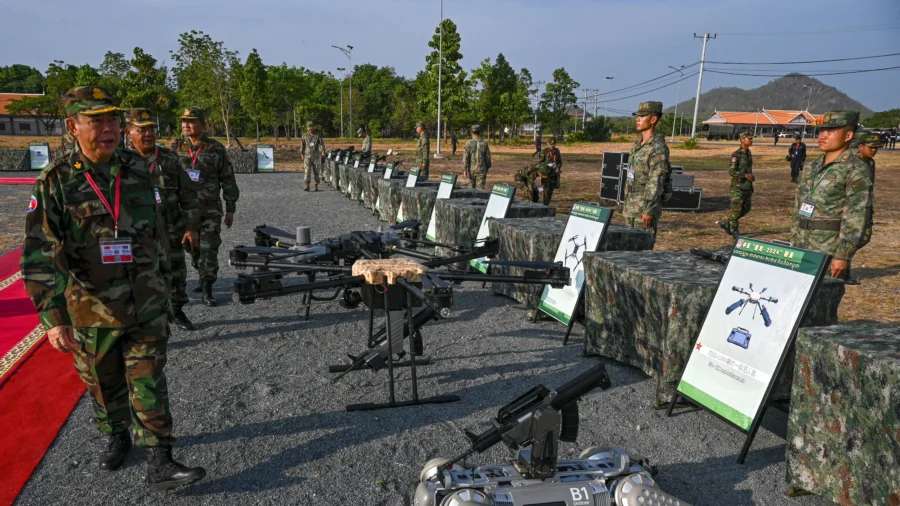
On July 25, U.S. Ambassador to the U.N. Dorothy Shea
urged China to stop selling what she called dual-use technology to the Russian military. Case in point were engines used to build Russian-made drones, rather than actual China-made drones. “Chinese-produced components [are] in the drones, weapons, and vehicles that Russia uses against Ukraine,” she said during a United Nations meeting.
Her comments come at a time when Sen. Lindsey Graham (R-S.C.) is
still shopping around his
Sanctioning Russia Act of 2025, a bill with 85 co-sponsors from both parties that would see China hit with tariffs for buying Russian oil. This move would clash with China’s 2024 decision to restrict drone exports globally in a bid to avoid the perception that its products are aiding wars against U.S. allies.
Still, secondary sanctions targeting China for buying Russian oil are unlikely, said geopolitical risk analyst Tony Nash. Though not impossible, he added.
“I think the secondary sanctions are unlikely, but they still wouldn't surprise me,” Nash told NTD on Wednesday. Nash is CEO and founder of Complete Intelligence, an artificial intelligence platform for business and financial market forecasting. He built the Asian consulting business for IHS Markit, purchased by business intelligence firm S&P Global in 2020.
“Trump understands that the U.S.-China relationship is huge. He needs to reset it, but I don't believe he wants to cause actual harm to either country,” he said about punishing China for buying Russian oil and gas, a product they’ve been purchasing and investing in since before the
Ukraine war began in 2022. While in Scotland on July 28, Trump gave Russia
10 days to end the war or face higher tariffs and new sanctions, including secondary sanctions on countries helping prop up Russia’s economy through oil purchases.
On Thursday, Treasury Secretary Scott Bessent backed Graham’s bill and
said he expects “most of the Western alliance that has been supporting Ukraine to follow that. So I think anyone who buys sanctioned Russian oil should be ready for this.”
Regardless of what happens next week as Russia’s 10-day time limit expires, drone tariffs are likely as the United States tries to develop this important segment of autonomous vehicles in a market dominated by Chinese manufacturers.
The U.S. Commerce Department began a so-called
Section 232 investigation into drone imports in July. Usually such investigations lead to import quotas, or tariffs of a minimum of 25 percent.
China Restricts Drone Exports to Avoid US Blowback
In September of 2024, Beijing restricted global exports of drones following claims they were supporting the Russian war effort. Ukraine, which also, ironically, purchased Chinese drones, had worried at the time that they would face a shortfall of drones and drone parts, the Royal United Services Institute in the UK
said in a report. At the time, China had only restricted temporary exports of large drones to Russia and Ukraine before finally going global with its export curbs last fall.
The restrictions triggered a 60 percent drop in Chinese drone imports to the United States over a seven-month period ending in April, according to the
Financial Times. Prices rose by 50 percent, exposing how reliant the U.S. remains on Chinese-made drones for both commercial and defense-adjacent sectors.
As it is now, even with restrictions still in place, China has around 90 percent of the U.S. commercial drone market and an 80 percent share worldwide in the civilian/hobby sector, according to an Atlantic Council
report in June.
“Let’s put it this way, we would have to look closer at China restricting drones so as not to have its products used in wars before we gave Xi Jinping too much credit on those restrictions,” said Chris Balding, a senior fellow at the Henry Jackson Society, a foreign policy think tank in London. “China has been known to say things publicly and do the opposite,” Balding told NTD.
China’s
CBTS.611000 drone, used for reconnaissance and as a decoy with warhead capabilities, was allegedly
found by the Ukrainian military in a war zone. Worth noting, Ukraine does not have any Chinese drone makers on its recommended
sanctions list.“Even if the drone isn’t made in China, many of the components are,” said Balding. “They can be assembled in Iran and passed to Russia. There’s also a black market, and rumor has it that some drone makers will sell for cash, no questions asked. I wouldn’t be surprised if a Chinese military colonel was smuggling drone parts to Russia,” he added. “That’s completely plausible.”
China exported an estimated 3.72 million fully assembled drones in 2024, valued at around $2.1 billion, according to the
South China Morning Post on July 15.
The United States was the leading destination for Chinese drones in 2024. Most drones are for commercial or retail use, as Chinese drones were
banned for U.S. military use by the Department of Defense in 2018. One of those banned entities is DJI Systems, one of the best-selling retail market drones, and allowed for sale to American consumers on Amazon.