

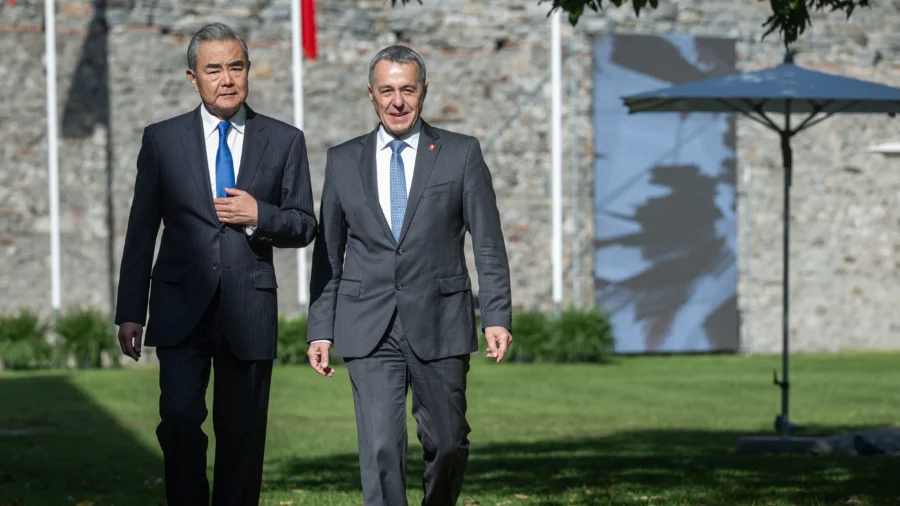
China’s Foreign Minister Wang Yi visited Italy and Switzerland this week, and although Beijing has not admitted it, a major goal of that trip is to keep Europe as close to China's supply chains as possible. At the moment, Europe is faced with the Trump administration’s “us or them” trade policy when it comes to allies and their ties to China.
What Official China Is Saying
Yi was in Italy for the 12th Joint Meeting of the China-Italy Government Committee before visiting Switzerland for the China-Switzerland Foreign Ministers' Strategic Dialogue. The meetings end on Sunday.On Chinese social and official channels this week, accounts linked to state organizations and overseas Chinese media stressed that Italy remains “an equal partner of ancient civilizations” and that ties should be upgraded to China-Italy 2.0, a euphemism for persuading Italy away from U.S.-style decoupling from Chinese industry.
The China-Italy “balancing act” was a recurring motif in Chinese-language coverage aimed at overseas readers in Rome.
Official readouts pushed “upgrade to 2.0” and anti-decoupling language.
In a loosely disguised swipe against the Trump administration, Yi blamed “unilateral bullying” for forcing allies away from China and being detrimental to European relations.
State media packaged the Rome meetings as a bid to portray momentum and remind Italy of the investment opportunities in China’s market, a market that has absorbed numerous Italian industries over the years.
Still, Yi framed China and Italy as both supporters of free trade and an open world economy. He touted China as “the most suitable and broad platform” for Italian companies to grow, meaning to invest in maintaining China as its go-to supply chain for manufactured goods.
Switzerland: China on Neutral Ground
In Switzerland, China has found its best friend in all of Europe. It could also explain why Switzerland has 39 percent tariffs compared to the rest of Europe’s average tariff rate of 15 percent.The two countries signed a free trade agreement in 2014. They are renegotiating an expansion of that deal, a deal that will surely keep Switzerland's tariffs high.
Switzerland’s China policy has historically prioritized commercial interests over human rights, said Ariane Knüsel, a Swiss academic at the University of Fribourg specializing in Chinese relations with Western countries. Switzerland’s recognition of China after the communist revolution in 1949 was largely pushed by Swiss multinationals looking to gain a foothold there over European rivals.
“Since then, Switzerland has consistently refused to impose sanctions on China,” she told NTD in an interview.
In recent years, there have been numerous articles about Chinese spy operations in Switzerland, such as Chinese scholars with ties to the People’s Liberation Army participating in Swiss research projects to obtain Swiss know-how via industrial espionage.
When China announced plans for a cultural center in Bern last year, the Swiss media immediately speculated it would be a hub for espionage, said Knüsel.
“The Swiss public is decidedly wary of the Chinese due to fears of espionage and subversion,” she said. “At the same time, Swiss companies and politicians act with a naivety toward China that is difficult to understand considering what is known about them historically and globally.”
Successful, pro-China lobbying efforts by Swiss multinationals are one reason why Switzerland never imposed sanctions against China like Washington and Brussels.
“There is significant criticism of Switzerland’s refusal to impose sanctions on China while the EU has imposed many,” Knüsel said. “There is considerable consternation that Switzerland prioritizes trade over human rights. Of course, some European publications suggest that their country should take the Swiss road and improve commercial relations with China.”
That may be, but it will surely lead to further de-industrialization, as evidenced by Italian textiles. Meanwhile, if the Trump administration believes European countries, whether in the EU or not, are setting themselves up to be export hubs for Chinese multinationals, tariff deals will likely be off the table. In some cases, like cars, they could even go higher. Yi likely knows this and faces the difficult task of presenting China as both a future opportunity and an innocent victim, hoping Italy and Switzerland, at least, will not see their relationship with China as a headwind for their relationship with the United States. Yi will have to be mindful that he is not putting European countries in a risky position through free trade and investment deals that may ultimately worsen relations with their biggest export and defense partner—the United States.