


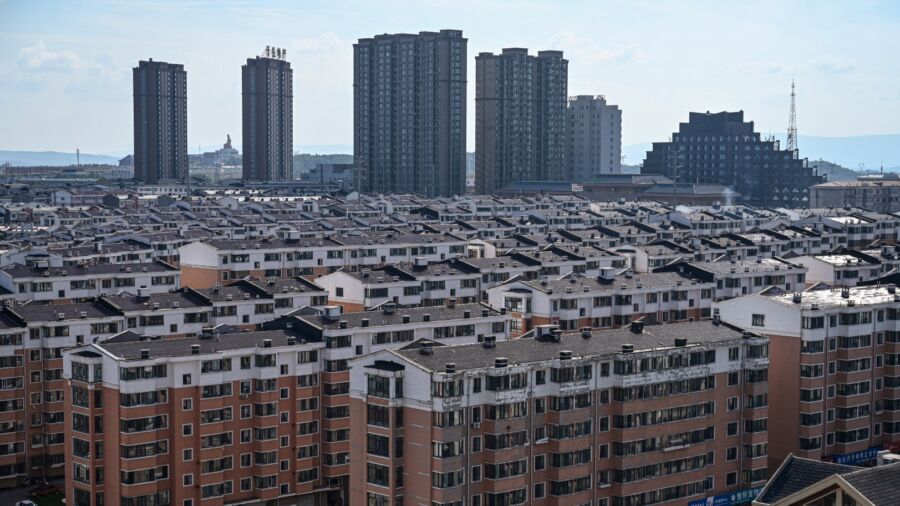
For struggling home sellers in China, insult has been added to injury—Chinese banks have now entered the market directly, selling repossessed properties at prices far below market value.
Since the beginning of November, multiple Chinese media outlets have reported on this unprecedented phenomenon of banks acting as direct sellers. Unlike the slow and complicated judicial auction (foreclosure) process, commercial banks are now taking a more direct and quicker approach to accelerate cash inflow.
From metropolitan cities to small county towns, the supply of bank-owned properties is huge, and the prices are surprisingly low.
For instance, on Singles’ Day (Nov. 11)—China’s version of Black Friday—a 176 m² (1,894 sq. ft.) apartment in Harbin was sold for just 315,000 RMB ($44,000)—a jaw-dropping discount—half price of the same unit in the same community.
He explained that banks are pricing these properties 30 percent lower, or even 50 percent, and in desperate cases up to 70 percent off, delivering a severe blow to the already devastated Chinese housing market.
Additionally, regional commercial banks have also been active: Jilin Bank has listed 2,099 properties, Tianjin Bank 1,227, Zhongyuan Bank 521, Wenzhou Bank 412, Dalian Bank 226, and Harbin Bank 159.
Banks Turned Vendors
Why are banks selling houses directly instead of relying on court-run judicial auctions for foreclosed properties?The main reason is that judicial auctions have become ineffective, time-consuming, and have ultra-low returns.
On the other hand, the entire auction process—from loan default, to the litigation, then judicial auction, and the final sale—might routinely take up to two to three years or longer. During that period, the risk of further asset depreciation kept rising.
A Deeply Bearish Market
Experts warn that as property prices keep sliding amid weakening economic conditions, the trend is dealing a severe blow to an already fragile housing market.Chen, a real estate agent in Shenzhen, told The Chinese edition of the Epoch Times, “Banks selling houses directly is definitely pushing prices down further. But price isn’t the only problem right now—the real issue is that nobody is buying. There are tons of desperate sellers and very few buyers. If there are any prospective buyers, they haggle relentlessly.
“Even agents have lost momentum and seem more sluggish than before,” he said.
Wu said he was “certain” prices will keep falling—now buyers are just sitting on the sidelines and observing. “Even those with cash are not jumping into the market.”
Chen added: “The more owners cut prices, the more buyers wait. Both sides are afraid prices will keep dropping, so they refuse to catch a falling knife.”