


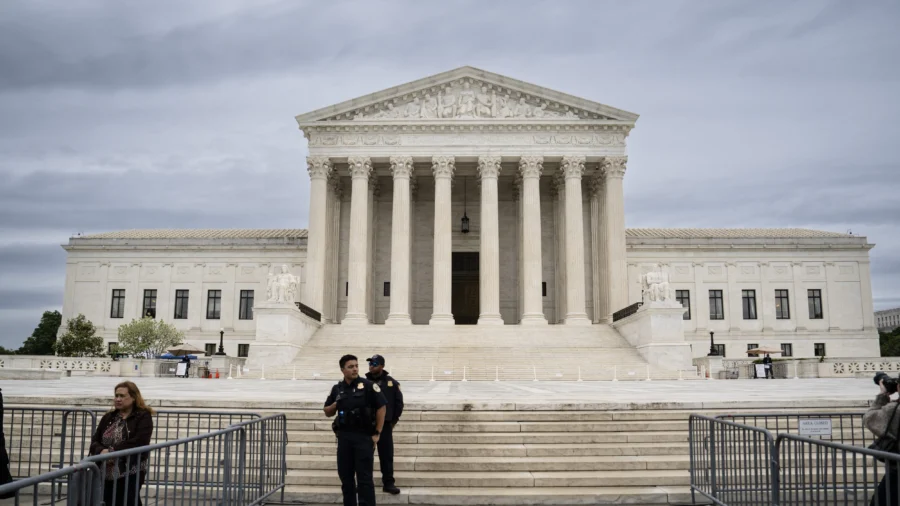
The U.S. Supreme Court late on May 4 took the unusual step of making its recent ruling to limit the use of race in redistricting effective ahead of the usual 32-day waiting period.
There are fewer than 32 days between April 29 and the first U.S. House primary elections that were scheduled for May 16, so if the waiting period were not waived, the primaries would have had to take place using the very same map the Supreme Court deemed unconstitutional.
Earlier, a federal district judge ruled that a version of the electoral map, which included one black-majority congressional district, discriminated against black voters who constitute almost one-third of the state’s population. She ordered the state to create a second black-majority district, and the state Legislature complied.
Non-black voters sued, arguing that the new map discriminated against non-minorities by engaging “in explicit, racial segregation of voters.”
Three judges on a federal district court panel agreed and ruled the map an unconstitutional racial gerrymander that disfavored non-black voters. Gerrymandering is the manipulation of electoral district boundaries to favor a particular party or constituency.
Last week, the Supreme Court affirmed the panel, ruling that race may only be a minor factor in redistricting rationales and not the predominant, overriding reason for how congressional district lines are drawn.
Federal courts have been applying the Supreme Court precedents on the federal Voting Rights Act’s Section 2 non-discrimination provisions “in a way that forces States to engage in the very race-based discrimination that the Constitution forbids,” the court said.
Here, the non-minority voters who filed the original lawsuit asked the court to issue the judgment immediately so that “in the event of a judicial remedy,” the district court will be in a position to “oversee an orderly process.”
Louisiana did not oppose the application, and while the minority voters who participated in the lawsuit oppose the request to expedite issuance of the judgment, “they have not expressed any intent to ask this Court to reconsider its judgment,” the Supreme Court said.
Justice Samuel Alito wrote a concurring opinion, saying, “there is good reason to depart from the default rule here.”
“The need for prompt action by this Court is clear,” Alito wrote in an opinion joined by Justices Clarence Thomas and Neil Gorsuch.
“The date scheduled for the beginning of early voting in the primary election has already passed. The congressional districting map enacted by the legislature has been held to be unconstitutional, and the general election will be held in just six months.”
“The Court’s decision in these cases has spawned chaos in the State of Louisiana,” Jackson wrote.
“By my count, we have granted an application to issue the judgment forthwith over a party’s objection only twice in the last 25 years,” she wrote.
“To avoid the appearance of partiality here, we could, as per usual, opt to stay on the sidelines and take no position by applying our default procedures. But, today, the Court chooses the opposite. Not content to have decided the law, it now takes steps to influence its implementation.”
Alito addressed Jackson’s dissent, saying that the charges she levels in it “cannot go unanswered.”
The dissent would force Louisiana to hold its elections using a map that has been ruled unconstitutional, and offers two justifications, one of which is “trivial at best,” while the other is “baseless and insulting,” Alito said.
There is good reason to depart from the 32-day rule because the election cycle in Louisiana has arrived and the map was ruled unconstitutional, he said.
The dissent’s claim that “our decision represents an unprincipled use of power” is a “groundless and utterly irresponsible charge.”
“What principle has the Court violated? The principle that Rule 45.3’s 32-day default period should never be shortened even when there is good reason to do so? The principle that we should never take any action that might unjustifiably be criticized as partisan?” Alito said.
Although the dissent “accuses the Court of ‘unshackling’ itself from ‘constraints,’” in reality it is “the dissent’s rhetoric that lacks restraint.”