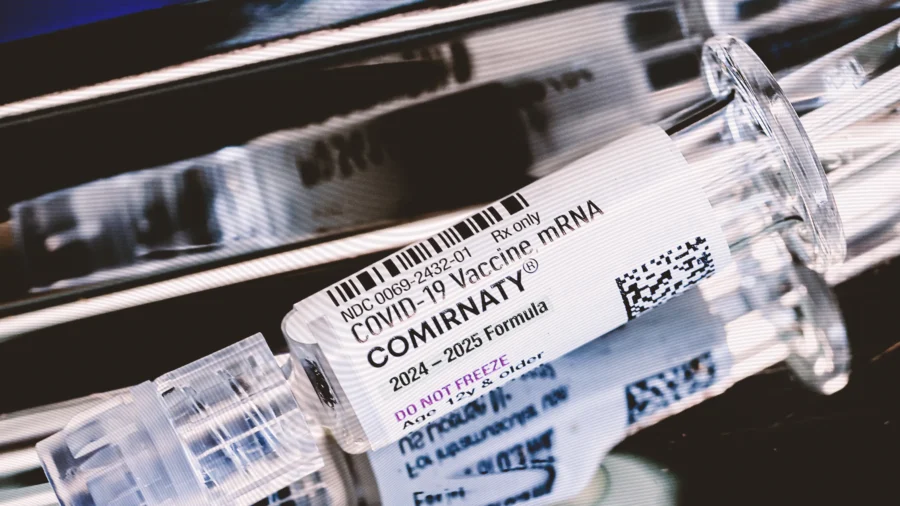
Companies that manufacture COVID-19 vaccines have pledged to conduct fresh trials for the shots, according to newly released documents.
Pfizer and BioNTech have committed to carrying out a randomized, double-blind, placebo-controlled trial to evaluate the safety and efficacy of their COVID-19 vaccine in adults aged 50 to 64 who do not have any conditions that
are said to place them at increased risk for severe COVID-19, Dr. David Kaslow, an official with the Food and Drug Administration,
said in one of the documents, an approval letter to the companies, dated Aug. 27.
Moderna has conveyed a written commitment to conduct a randomized, observer-blind, placebo-controlled study testing the safety of its two COVID-19 vaccines in the same population, Kaslow
said in another letter, sent to the company.
Novavax has pledged to run a randomized, observer-blind, placebo-controlled trial in the same population “to evaluate the circulating vaccine-derived spike protein,” based on “a comprehensive symptom survey,” according to Kaslow’s
letter to Novavax.
The Pfizer study is slated to be completed on July 31, 2026, according to the documents. The company will have until Jan. 31, 2027, to complete its final report on the trial.
Moderna’s trial is to end by Jan. 31, 2027, with a final report due one year later. Novavax’s trial is not slated to be finished until Nov. 30, 2027. Its final report is not due until May 31, 2028.
The companies did not respond to requests for comment.
The FDA referred a request for comment to its parent agency, the Department of Health and Human Services, which pointed to memorandums from Dr. Vinay Prasad, the FDA’s top vaccine official, on the new approvals.
Prasad said in the memos that encouraging the companies to run randomized clinical trials would help regulators determine if the benefits of the vaccines outweigh the risks in younger, healthy individuals.
“FDA has a statutory mandate to only approve products when we have substantial certainty benefits outweigh harms and, in cases when we do not, sponsors are free to prove to the agency and the American people the worth of their products with randomized trials,” he
said in one memo.
FDA leaders
said in May they would no longer approve COVID-19 vaccines for people younger than 65 who lack one of the risk conditions, absent clinical trial data.
The companies have also committed to running additional studies, including studies assessing the immunogenicity and safety of the vaccines in the populations for whom they were approved.
Pfizer and Moderna will also run studies looking at the COVID-19 spike protein and symptoms following vaccination or COVID-19, similar to Novavax’s randomized trial.
“There is growing clinical evidence that spike protein, which is generated as a result of or in the course of vaccination, may persist for some time in a subset of individuals,” while the symptoms of so-called long COVID are “ill-defined but concern many Americans,” and some believe the two are linked, Prasad
said in another memo. The FDA is thus requesting the companies “generate information which may link or exculpate any such relationship,” he said.
The studies could also show that the vaccines reduce symptoms of long COVID, Prasad added later.