


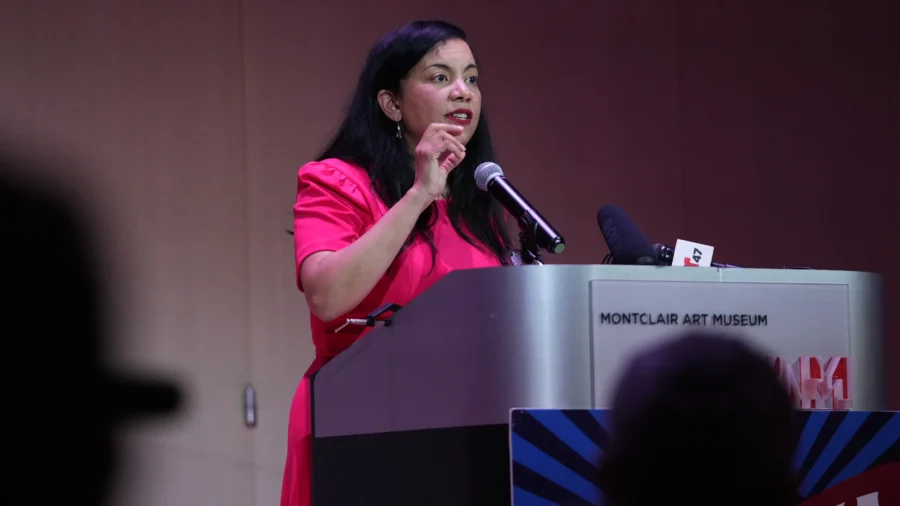
Analilia Mejia, a Democratic activist and labor organizer, won the April 16 special election to fill New Jersey Gov. Mikie Sherill’s former seat in Congress.
Shortly after the Associated Press called the race at 8:07 p.m. ET, Mejia led Republican mayor Joe Hathaway by around a 40-point margin to take the seat for New Jersey’s 11th Congressional District.
Mejia’s victory narrows the Republican majority in the House from 217–213 to 217–214. Rep. Kevin Kiley (I-Calif.) caucuses with the Republicans, giving them a 218-vote majority.
With Mejia’s election, there are three vacancies in the House, including two caused by the resignations of Reps. Eric Swalwell (D-Calif.) and Tony Gonzales (R-Texas), and the third caused by the death of Rep. Doug LaMalfa (R-Calif.).
The result highlights the continued political shift in New Jersey’s 11th Congressional District, which spans parts of Essex, Morris, and Passaic counties. Once a reliably Republican stronghold, the district began trending Democratic during Donald Trump’s first term, when Sherrill flipped the seat in the 2018 midterm elections.
Mejia’s platform included abolishing Immigration and Customs Enforcement, breaking up monopolies, enacting national paid sick leave, Medicare for all, free public college and forgiving student loan debt, ending corruption in Congress, reforming the Supreme Court, and pushing back on Wall Street.
Hathaway, the mayor of Randolph, New Jersey, ran on eliminating taxes for first-time homebuyers, capping student loan interest, expanding the child tax credit, lowering health care costs, investing in transportation, lowering energy costs, creating jobs, backing law enforcement and securing the border, and stopping wasteful spending.
Mejia secured the Democratic nomination in a closely contested Feb. 5 special primary, edging out a crowded field that included former Rep. Tom Malinowski (D-N.J.) and former Lt. Gov. Tahesha Way. Malinowski had been seeking a return to Congress after losing a neighboring district in 2022. Hathaway ran unopposed for the Republican nomination.
The race was shaped in part by debate over the Israel–Hamas War. A super PAC affiliated with the American Israel Public Affairs Committee spent more than $2.3 million opposing Malinowski after he questioned unconditional U.S. aid to Israel. During the primary, Mejia stood out as the only candidate to say she believed Israel had committed genocide in Gaza. Hathaway, by contrast, has argued the U.S. should remain “in lockstep” with Israel and opposes placing conditions on aid.
The United States has denied that Israel committed genocide in Gaza.
In terms of fundraising, Mejia raised approximately $1.1 million across the primary and general phases of the race and reported about $374,000 cash on hand as of March 27. Hathaway raised roughly $525,000 and had about $109,000 remaining.
Before her election, Mejia served as director of the Working Families Alliance in New Jersey, where she advocated for progressive policies in the state capitol. She was also political director for Bernie Sanders’ 2020 presidential campaign and later worked as deputy director of the Women’s Bureau at the U.S. Department of Labor under Joe Biden.
Along with Sanders, Mejia was endorsed by Sen. Elizabeth Warren (D-Mass.) and Rep. Alexandria Ocasio-Cortez (D-N.Y.).
Because the special election determines only who will complete Sherrill’s current term, voters will return to the polls for a regularly scheduled primary on June 2, followed by a general election on Nov. 3 to decide the next full term.