News Analysis
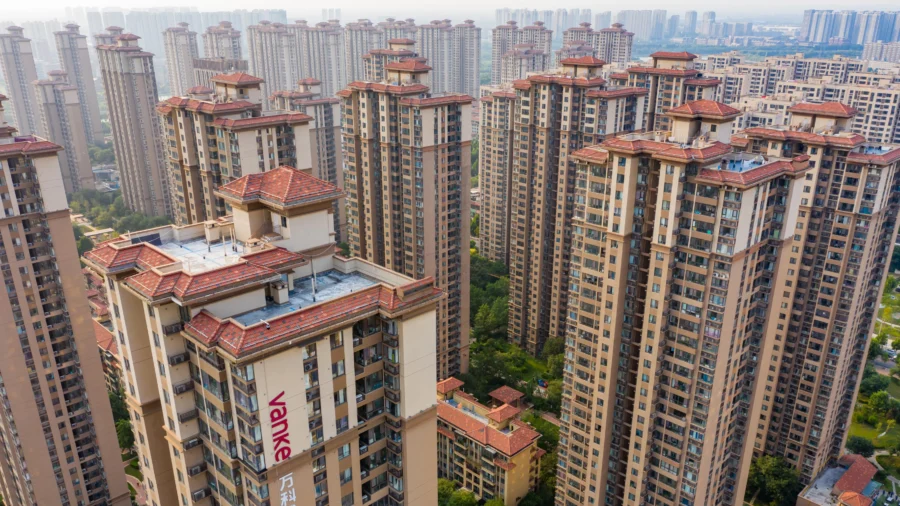
China's property slump persisted despite policymakers’ efforts to stabilize the real estate sector.
New home prices in the country remained flat for a second straight month in April and have demonstrated no growth since May 2023, official data released on May 19 showed.
China’s National Bureau of Statistics said investment in real estate development in the first four months of the year fell by 10.3 percent from the same period in 2024.
Sales prices for new residential properties were down year over year in all but two cities—Shanghai and Taiyuan—the Bureau said.
Policymakers have been trying to lift the real estate sector, once a key driver of the economy, from a property crisis that began in 2021.
"The property sector remains on a downward path. While many believe we're approaching the bottom, the exact distance remains uncertain," said Zhaopeng Xing, senior China strategist at ANZ.
Existing problems of population decline, pre-sold, unfinished apartments waiting for occupancy, plus high vacancy rates for both residential and commercial real estate are exacerbated by external pressures on the Chinese economy
such as U.S. tariffs.Housing accounted for more than a third of China’s GDP at its peak in 2015. It has fallen to 20 percent, according to Paul Hodges, chairman of New Normal Consulting in Switzerland and advisory board member at the Independent Commodity Intelligence Services. That lower percentage number might look benign if other sectors of the economy were picking up the slack, but that is not the case. The real estate slowdown is having a major impact on local government finances—Goldman Sachs estimates a shortfall of around $4.1 trillion—as land sales are their major source of revenue.
A Decade of Warnings
For years, economists such as former International Monetary Fund chief economist Kenneth Rogoff have
warned about cracks in China’s real estate foundation. Stimulus has revived the sector in the past. But this time, multiple headwinds are converging and China is seeing weakening investor confidence.
As an example of that erosion in confidence, a Reuters survey conducted in May forecasts home prices to fall by nearly 5 percent in 2025. That forecast might understate the true risk. According to China Index Academy, average home prices are already down 30 percent from their pandemic peak. Recall that real estate giant
Evergrande’s 2021 default and the subsequent wave of distressed developers had already shattered the perception of real estate as a guaranteed store of value in China.
A failing real estate sector profoundly impacts Chinese families since property remains the dominant asset class in China. JP Morgan estimates that 65 percent of household wealth is tied up in real estate.
Moreover, fewer young people are buying homes due to prices in Tier-1 cities like Shanghai, as well as concerns about new properties taking longer to build than initially promised to the buyers. Millions of units are vacant—especially in smaller cities with fewer job prospects.
Data shows that the strain facing China’s Tier-1 cities is real. A look at residential real estate vacancies:
- Shanghai: Q1 2025 rental vacancy rate reached 20.6 percent, up from 19 percent a year earlier.
- Shenzhen: Q1 2025 vacancy rate was 29.8 percent, up from 27.6 percent in Q4 2023.
Comparisons with residential vacancy rates in international markets are telling:
- New York City: 3.2 percent
- Washington: 4 percent
- Dallas–Fort Worth: 11.3 percent
- Denver: 7 percent
- Singapore and Seoul: Below 4 percent.
No reliable Q1 2025 vacancy data exists yet for Tier-2 cities.
The Chinese regime is once again attempting to revive the market with
a number of policies, such as “trade-in” programs where residents can trade in old homes for new ones, or upgrading infrastructure to make older neighborhoods more livable. The regime has also allowed for state banks to lower downpayment requirements to 20 percent from 30 percent.
Will it work?
Global real estate services firm Savills, in its 2025 China Real Estate Market Outlook,
said Beijing’s latest support is “not aimed at bailing out the sector but rather at preventing it from further hindering economic growth.”
Savills suspects that results will vary by region. Cities like Shanghai may weather the storm, and based on the National Bureau of Statistics' most recent sales numbers, it indeed is weathering the storm. Other cities, like Tier-2 cities Yantai and Wenzhou, are grappling with weak demand and rising vacancies.
These high vacancy rates and lackluster sales figures can indicate new supply but also speak to deeper issues—such as affordability, job migration, and economic contraction.
Policymakers face a narrowing path to restore confidence without exacerbating the debt load by throwing money at real estate developers, developers who until now cannot even deliver on projects already sold.
Still, not all indicators are as bleak.
An April report by Oxford Economics
predicts confidence in the property sector will recover slowly this year thanks to state intervention.
Office real estate is in better shape, even though vacancies are high. According to
CBRE, new supply of office space in top cities dropped 40 percent in the first quarter of 2025 versus the previous quarter, meaning more companies were taking up rents. Leasing activity exceeded vacancies. Vacancy rates are still high, however, averaging 23.5 percent in Beijing, Shanghai, and Shenzhen, CBRE said.
Warehousing real estate is doing well. CBRE said national warehousing demand reached its highest first quarter total on record, driven by e-commerce and exports.
China’s Slow Burn
China faces numerous geopolitical headwinds. On the home front, housing makes things worse as real estate is a core source of development and lending. Despite stimulus, China’s housing market will likely never be the same due to long-term demographic and structural realities.The
total value of outstanding housing loans to households was RMB 37.7 trillion (about $5.3 trillion) at the end of 2024, representing 27.9 percent of GDP—down from 33.3 percent in 2020, based on the Central Bank’s fourth quarter credit report. This drop reflects both a decline in the absolute value of outstanding home loans and a slowdown in new home loan issuance by lenders. One way to read that is that fewer people are taking on new mortgages.
Some see the recent stimulus as stabilizing the real estate market.
The Asia Development Bank
noted in April that policy support for real estate could soften the property downturn. But with youth unemployment high, consumer confidence in freefall since 2022, and foreign investors growing wary, China’s long-standing growth engine is sputtering.
Others are more bearish.
“China’s economic crisis is accelerating,”
wrote hedge fund manager Kyle Bass on May 4. He cited the closure of 1,800 manufacturing facilities in a single month and called it “the worst real estate and banking crisis” China has faced.
If real estate was once the ballast of the Chinese economy, it is now its heaviest anchor. The question is no longer whether the market will recover—it could eventually. The real question is what happens to China’s broader economy if its vast real estate ecosystem—from homebuyers to developers—remains stalled, just as Washington locks in a long-term strategy to decouple from China’s industrial base.
Reuters contributed to this report.