


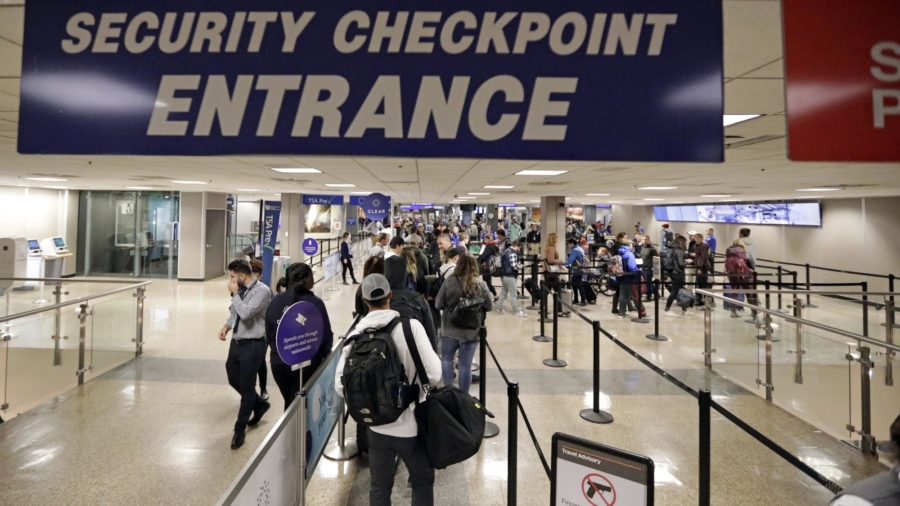
The Department of Homeland Security has finalized new rules that will require all non-U.S. citizens entering or leaving the United States to go through facial recognition screening at ports of entry nationwide.
The new rules remove age-based exemptions that previously allowed children under 14 and adults over 79 to skip biometric screening. Under the new system, all foreign travelers, regardless of age, may be photographed when crossing U.S. borders, though exemptions are still in place for other biometric data like fingerprints.
The change comes as CBP works toward full implementation of a congressionally mandated biometric entry-exit system designed to track foreign visitors and identify those who overstay their visas. Federal law has required such a system since 1996, with multiple statutes reinforcing the mandate following the Sept. 11 terrorist attacks.
CBP estimates the system can be fully deployed at all commercial airports and seaports within three to five years. The technology has already been implemented through a process called Simplified Arrival at air entry points and through various programs at sea and land crossings.
The facial recognition system works by comparing live photographs of travelers against a database of images from passport applications, visa applications, and previous border inspections. The agency creates digital galleries based on flight manifests and vessel arrival information, then matches incoming travelers against those pre-loaded images.
According to the National Institute of Standards and Technology, the facial comparison technology achieves match rates exceeding 98 percent. CBP officials say the system provides faster processing than traditional fingerprint verification while maintaining accuracy.
For fiscal year 2022, DHS estimates approximately 853,955 non U.S. citizens who entered by air or sea overstayed their authorized period of admission, representing 3.67 percent of such arrivals. Officials say biometric exit tracking will help identify visa overstayers and prevent illegal reentry.
The regulation maintains that American citizens are not required to participate in facial recognition screening. U.S. travelers may ask for an alternative screening, though such could result in travel delays or hinder travel, the agency said.
CBP says it will delete photographs of U.S. citizens within 12 hours of verifying their identity and citizenship. However, photos of foreign nationals will be retained in government databases for identity verification and immigration enforcement purposes.
According to cost estimates, implementing the biometric system will generate between $1.3 billion and $993 million in costs through 2029, depending on discount rates applied. The agency projects annualized costs ranging from $119 million to $122 million, partially offset by time savings for travelers and improved processing efficiency.
The rule authorizes CBP to collect facial images through cameras owned by the agency, airlines, airports, cruise lines, or other federal agencies like the Transportation Security Administration. Private sector partners must immediately delete collected images after transmission to CBP and cannot keep photos for their own business purposes.
Foreign travelers who refuse to be photographed may not be admitted or face violations of their immigration status when CBP requires the information to verify identity. The agency says alternative verification methods will be used when technical failures prevent facial matching.
CBP has posted signage at ports of entry informing travelers about biometric collection, although the agency said some locations may lack adequate notice. The agency said it is working to ensure proper signage displays, opt-out information for U.S. citizens, and details about the collection process.
The facial recognition expansion extends to pedestrian crossings at land borders, commercial sea vessel passengers, and commercial air travelers. The agency is developing strategies to use biometric exit screening at land border vehicle crossings, private aircraft operations, and departure points at seaports and pedestrian land crossings.
Officials say the technology helps combat passport fraud, identity theft, document forgery, and terrorist threats.
The 9/11 Commission previously identified comprehensive biometric screening as essential for combating terrorism. A 2017 United Nations Security Council resolution called on member nations to implement biometric data collection systems to identify terrorists, with the measure passing unanimously.
CBP will continue accepting public comments for 30 days on specific implementation processes at new facilities. The final rule takes effect 60 days after publication in the Federal Register.