


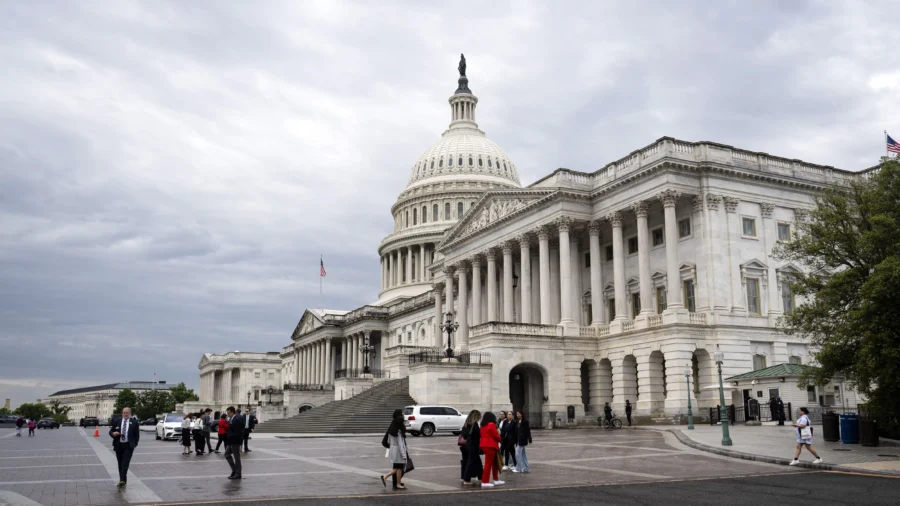
The U.S. Senate halted a resolution on April 28 to bar President Donald Trump from being able to direct military action against Cuba without first obtaining affirmative Congressional approval.
Senators voted 51–47 against advancing the Democrat-led resolution to a final vote.
Similar Democrat-led war powers votes concerning U.S. military actions against Venezuela and Iran have also failed in the Republican-controlled Senate in recent weeks.
U.S.–Cuba relations have remained contentious since Fidel Castro swept to power in Havana in 1959 at the head of a communist revolution.
The U.S. government led efforts to overthrow Castro in the 1960s. CIA officers helped arm and train Cuban exiles who led a failed invasion to retake the country in April of 1961. After this failed invasion attempt, the CIA continued to develop covert methods to weaken Castro’s hold on power through an effort known as Operation Mongoose.
Since the 1960s, the U.S. government has maintained pressure on Cuba through economic sanctions and trade restrictions.
Under Castro’s leadership, Cuba aligned with the Soviet Union.
Under the current leadership of Miguel Díaz-Canel Bermúdez, Cuba has continued to maintain ties with Russia, China, and Venezuela.
Trump signed an executive order on Jan. 29 declaring Cuba “an unusual and extraordinary threat” to the national security and foreign policy of the United States. The order notes Cuba’s continued military cooperation with China, Russia, and Iran, and asserts Havana has welcomed designated terrorist groups like Hamas and Hezbollah.
As part of his Jan. 29 executive order, Trump imposed new tariffs on countries selling oil to Cuba. The Caribbean island nation has faced recent blackouts as it has struggled to maintain its energy supply.
“Donald Trump has bypassed Congress’s sole authority to declare war with attacks on Iran and Venezuela,” Schiff said ahead of the Tuesday vote. “The president’s saber rattling toward Cuba makes clear where his sights are next.”
Sen. Rick Scott (R-Fla.) took to the Senate floor to challenge the Democrat-led war powers resolution, arguing that the measure lacks relevance because U.S. troops aren’t currently deployed in Cuba.
“President Trump has never said he wants to put boots on the ground. I don’t think any of my Republican colleagues have said it. Even Lindsey Graham has not said it,” Scott said.