

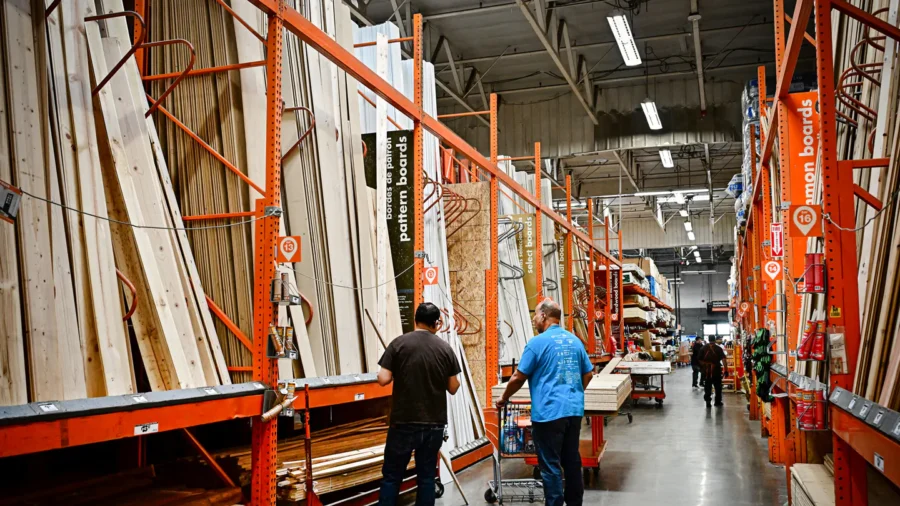
Home Depot on May 19 reported first-quarter sales of $41.8 billion, a 4.8 percent year-over-year increase, bolstered by its revamped product-delivery service and stronger demand for seasonal home-improvement products.
Home Depot’s adjusted earnings per share for the first quarter of fiscal 2026, which ended May 3, were $3.43 versus year-earlier earnings per share of $3.56. Net earnings of $3.29 billion dipped 4.2 percent from the first quarter of fiscal 2025, when it reported net earnings of $3.43 billion.
Comparable sales ticked up by 0.6 percent from the same period in 2025, driven by increased sales in nine of 16 primary merchandising categories as homeowners kicked off a spate of springtime do-it-yourself projects, Billy Bastek, Home Depot’s executive vice president of merchandising, said during a conference call with industry analysts and investors.
Homeowners led the boost in sales in storage, power, hardware, plumbing, electrical, bath, indoor garden, paint, and kitchens, while professional contractors led the uptick in sales of power, pipe and fittings, water heaters, fasteners, and paint, Bastek noted.
“We had great engagement in spring-related projects,” Bastek said.
“Our comp average ticket increased 2.2 percent and comp transactions decreased 1.3 percent. Big-ticket comp transactions for those over $1,000 were positive 0.8 percent compared to the first quarter of last year.”
Home Depot reaffirmed its fiscal-year 2026 guidance for sales growth of 2.5–4.5 percent and earnings per share growth of up to 4 percent. The home improvement retailer’s stock tumbled by more than 3 percent in early morning trading, but recovered to a modest 0.65 percent increase approaching the midday mark.
Home Depot’s investments to improve customer shopping experiences, along with expanded product offerings through partnerships with paint suppliers Behr and PPG, led to a 10 percent year-over-year increase in digital sales, Bastek added.
The increase in sales comes as consumers continue to grapple with rising energy costs and economic uncertainty, while soaring fuel prices affect logistical and freight margins for big-box retailers. Still, builder materials suppliers sold $35.7 billion of goods in March, a 26.7 increase from the prior month, the Federal Reserve Bank of St. Louis reported.
Home Depot also has been expanding its reach, acquiring SRS Distribution in June 2024 to boost its presence in the roofing, landscaping, and pool industries. On March 24, Home Depot announced that SRS Distribution would acquire HVAC wholesale distributor Mingledorff’s Inc. to expand its presence in HVAC equipment and supplies throughout the southeastern U.S.
Meanwhile, the company has made investments to improve digital customer shopping experiences.
Those efforts, coupled with expanded product offerings through partnerships with paint suppliers Behr and PPG, led to a 10-percent year-over-year increase in digital sales in the first quarter, Bastek added.
Home Depot has been retooling its delivery model to ensure goods are shipped from the best location to speed up delivery times, and that work resulted in exponential growth in delivery sales, noted senior executive vice president Ann-Marie Campbell.
“Over the last several quarters, we’ve leaned into faster delivery for customers,” she said.
“We’re evolving our sourcing logic and have begun to route orders to the optimal store for fulfillment based on distance, inventory availability, and speed of delivery, which improves the likelihood of a successful delivery.”
Home Depot’s delivery network spans a fleet of about 16,000 vehicles and a professional sales force of more than 5,000 associates. At the end of the first quarter, the company had 2,361 stores, 325 customer-facing warehouses, and more than 1,300 wholly owned SRS Distribution locations. It expects to open an additional 15 Home Depot locations in 2026, as well as 40–50 new SRS Distribution locations.