


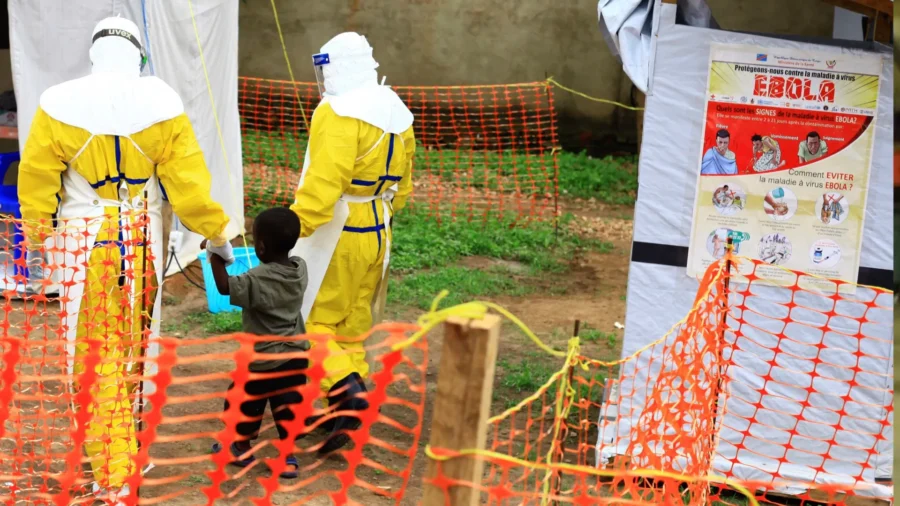
A new outbreak of Ebola has been confirmed in the Democratic Republic of Congo (DRC), the Africa Centres for Disease Control and Prevention said on May 15.
Preliminary testing confirmed Ebola in 13 of 20 samples tested, the Africa CDC said. Early results suggest a non-Zaire ebolavirus, with sequencing being performed to further characterize the strain.
Some of the suspected cases are in Bunia, the capital of Congo's Ituri Province, which borders South Sudan and Uganda. There is a risk of further spread of Ebola considering the population density and movement in the area, as well as insufficient infection control procedures, according to the Africa CDC.
Uganda’s Health Ministry said on May 15 that one patient died in intensive care on May 14 after contracting Ebola, which it said was an imported case from Congo. The patient had developed hemorrhagic symptoms.
Ebola is a disease caused by infection with an orthoebolavirus. It spreads through contact with saliva or other bodily fluids from infected people or contact with infected animals. Symptoms can include fever, diarrhea, and seizures. The average case fatality rate is around 50 percent, according to the World Health Organization (WHO).
Ebola was first identified in 1976 in Congo, a country in central Africa with about 109 million people.
Africa CDC officials said they are closely monitoring the new outbreak and will soon convene an urgent coordination meeting with authorities from Congo, Uganda, South Sudan, and global entities such as the WHO, the U.S. Centers for Disease Control and Prevention, and vaccine manufacturer Merck to determine priorities in responding to the new outbreak.
“Africa CDC stands in solidarity with the Government and people of the Democratic Republic of the Congo as they respond to this outbreak,” Dr. Jean Kaseya, director general of the Africa CDC, said in a statement.
“Given the high population movement between affected areas and neighbouring countries, rapid regional coordination is essential. We are working with DRC, Uganda, South Sudan and partners to strengthen surveillance, preparedness and response, and to help contain the outbreak as quickly as possible.”
The WHO recommends during outbreaks that people avoid contact with suspected cases, refrain from handling the bodies of people who had symptoms and died without appropriate protective measures, and regularly washing one's hands.
The Africa CDC said on Friday that it is recommending avoiding contact with people suspected to have Ebola, promptly reporting any symptoms that manifest to authorities, and providing support to teams responding to the outbreak.