


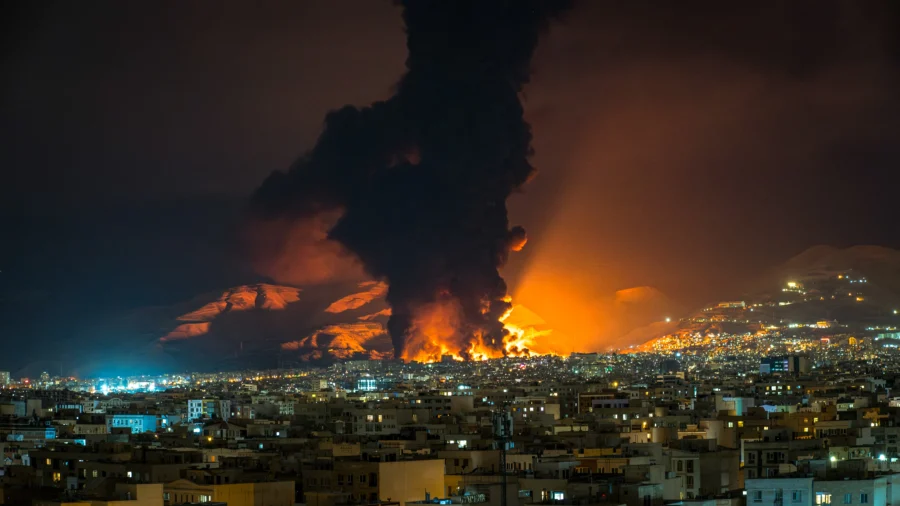
Joel Rayburn, senior fellow at the Hudson Institute, and Andrew Harding, national security analyst at the Heritage Foundation, joined a panel discussion with NTD's Steve Lance. The panel discussed the U.S. success of Operation Epic Fury in degrading Iran's ability to develop a nuclear weapon and ballistic missile systems to reach the U.S., and the strategic setback for the alliance of China, Russia, Iran, and North Korea (CRINK) and its junior partners that are now detached, like Venezuela, the Syrian regime, and the Cuban regime.
Rayburn says the Iranian regime was the 'hinge' supplier of energy to China and arms to Russia, with the drones devastating Ukrainian cities being Iranian-made. Rayburn also says the Iranian regime is trying to adapt drone missile warfare in the Russia-Ukraine war to the Gulf, without any defenses, and called it a failure of its strategic doctrine that they adopted after the Iran-Iraq war. The Iranian regime and its ability to project power in the Middle East and beyond will never be the same, Rayburn says.
Harding says Iran is hitting its partners in the Gulf region, did not bring countries closer to its side, or suggest the U.S. and Israel cease their military actions, but instead, showed the countries that the Iranian regime acquiring nuclear weapons or ballistic missiles is unacceptable as a threat to the region. Harding also says Iran's "unconditional surrender" to the U.S., that President Donald Trump demands, depends on the regime's willingness to continue fighting.
Rayburn says the Iranian regime's selection of Ali Khamenei's son, Mojtaba Khamenei, as the successor is a signal of the regime doubling down on the failed, hostile policy of his father. He says the Israeli military is hunting him, the leadership is not 'very survivable,' and that only under duress will the regime acknowledge they have to abandon their hostile policy.
Harding says the U.S. imports about 10 percent of its oil from the Middle East. He says 20 percent of the world's supply of oil and exclusive petroleum products goes through the Strait of Hormuz, and Iran is using the strait as leverage. Harding estimates some stabilization of the oil market as a result of the U.S. taking out the Iranian navy, establishing naval superiority, and supporting ships through the strait. Harding says the U.S. may see lower gas prices than with Iran involved. Rayburn says China is calculating the cost of the U.S. controlling the oil supply in the Persian Gulf in the event of a confrontation with the U.S. By losing a steady, discounted supplier in Iran, he says, China will lose having to market price.