



At least 50 people have been killed across China after a week of extreme weather brought devastating floods, rare tornadoes, and consecutive earthquakes to several regions.
Driven primarily by the remnants of Typhoon Maysak, torrential rain caused reservoirs to breach in the south, while violent convective storms have ravaged central regions.
Guangxi: Dam breaches and Floodwaters
The southern region of Guangxi has borne the brunt of the destruction. Rivers swelled to historic levels following record-breaking rainfall, causing several dikes and reservoirs near the regional capital, Nanning, to overflow or collapse.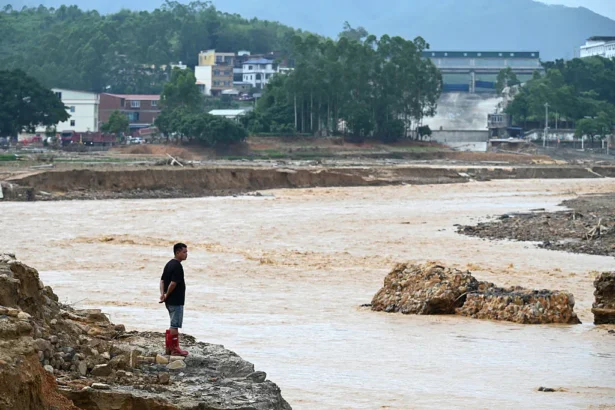
In Hengzhou, the breach of the Liulan Reservoir sent a torrent of water cascading into downstream towns, completely submerging roads, farmland, and residential areas.
As of July 9, official statistics report 39 deaths and 9 people missing, with a single reservoir breach accounting for 26 of those fatalities.
The disaster has affected at least 375,000 people, forcing the emergency evacuation of more than 130,000 residents. Massive amounts of housing, farmland, and infrastructure have been destroyed, leaving some residents temporarily stranded on rooftops awaiting rescue.

Hubei: Rare Tornadoes Cause High-Rise Fatalities
In central Hubei province, the intersection of the typhoon’s residual moisture with a cold front triggered a series of violent and historically rare tornadoes, with winds equivalent to an EF2 rating.The cities of Huanggang and Ezhou suffered catastrophic damage, with wind speeds strong enough to hurl cargo trucks up to 100 feet and tear the roofs off logistics parks.
According to official data, the storms have left at least 11 people dead, 1 missing, approximately 14,600 affected, and nearly 5,000 homes damaged, resulting in direct economic losses amounting to hundreds of millions of yuan.
The storms resulted in several horrifying fatalities within residential high-rises: In Huanggang, a residential block was partially gutted by the winds, violently sucking a resident out of a 12th-floor apartment.
In Ezhou, a family of three was swept out of their sixth-floor home and killed while attempting to close a window against the gales.
Sichuan: Shaken by Consecutive Earthquakes
As the country coped with atmospheric disasters, the southwestern province of Sichuan was hit by a sequence of shallow earthquakes centered around Yibin City.A magnitude 5.0 earthquake on Wednesday was followed by dozens of volatile aftershocks, which were felt as far away as the major metropolitan hubs of Chengdu and Chongqing.
While authorities have activated a Level 3 emergency response and reported no fatalities, local buildings have suffered structural cracking, leaving residents in a state of prolonged anxiety.
"It is shaking every single day," one local resident posted on social media.
"Every morning, noon, and night, I am being shaken awake. It makes you feel incredibly small in the face of nature." another one said.