


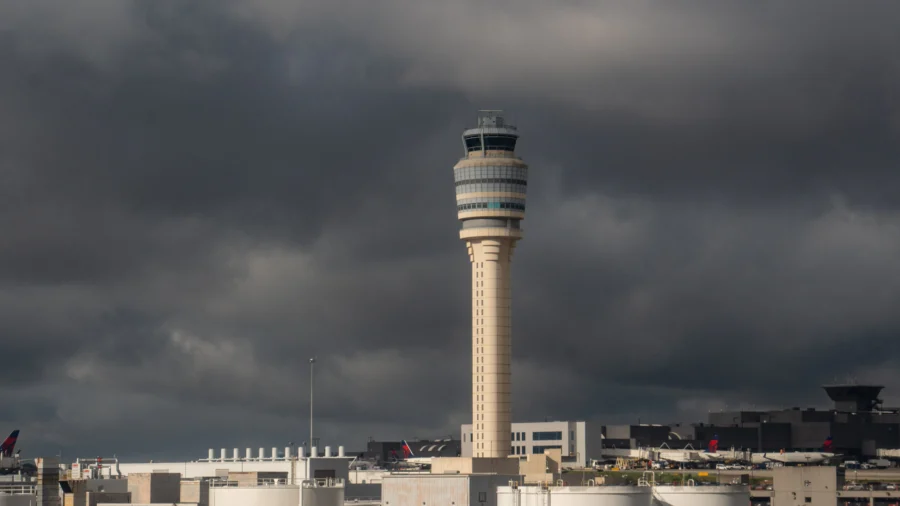
The Federal Aviation Administration (FAA) announced on March 18 that air traffic controllers at more than 150 airports are now required to use radar instead of visual checks to keep helicopters at a safe distance from landing and departing aircraft.
The change came more than a year after an apparent failure in maintaining visual separation resulted in the mid-air collision of an Army Black Hawk helicopter and an American Airlines regional jet attempting to land at Ronald Reagan National Airport in Washington on Jan 29, 2025. Both aircraft fell into the Potomac River, and 67 people lost their lives. There were no survivors.
The National Transportation Safety Board (NTSB) said on Jan. 27 that it found several “systemic failures” in its investigation of the incident that board chair Jennifer Homendy called “100 percent preventable.” One of those failures was that air traffic controllers were relying too heavily on the pilots to spot other aircraft themselves and maintain visual separation. The FAA did not dispute the board’s conclusions.
That crash—the deadliest on U.S. soil since 2001—was just one of several incidents where helicopters and planes failed to visually maintain a safe distance.
Other incidents included a near miss on Feb. 27 at San Antonio International Airport in Texas when a police helicopter flew through the final approach path of an American Airlines flight. Another near-miss occurred at Hollywood Burbank Airport on March 2, when a helicopter had to divert course after flying into the approach path of a Beechcraft 99 aircraft.
Effective immediately, visual separations must cease, and air traffic controllers are mandated to use radar to actively manage the necessary vertical and lateral distances between aircraft. The FAA also noted that these changes could result in new delayed helicopter departures or route adjustments, and airline operations could, likewise, face disruptions to yield for helicopters conducting urgent medical missions.
The FAA described it as the latest element of a long-overdue upgrade to safety protocol.
“The tragedy over the Potomac one year ago revealed a startling truth: years of warning signs were missed, and the FAA needed dire reform,” Transportation Secretary Sean Duffy said in a January news release. “Since then, we’ve implemented numerous changes to protect the skies over our capital and keep the traveling public safe.”