

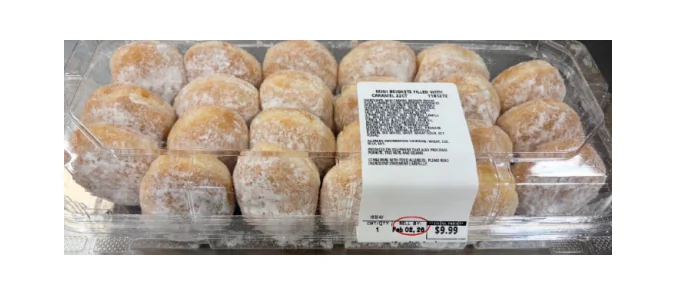
The U.S. Food and Drug Administration (FDA) assigned its highest risk to 8,073 packages of baked goods sold at Costco Wholesale in 22 states.
They include milk, eggs, fish, shellfish, tree nuts, peanuts, wheat, soybeans, and sesame.
Almonds, Brazil nuts, cashews, filberts, hazel nuts, macadamia nuts, pecans, pine nuts, pistachios, and walnuts are all considered tree nuts by the FDA.
Ingredients listed on the dessert’s label include wheat, egg, milk, and soy; however, tree nuts were undeclared.
Since the recall was initially announced on Jan. 31, the FDA assigned the bakery item its highest risk warning at Class 1.
A Class 1 event is defined on the FDA website as having a reasonable probability that the use of or exposure to will cause serious adverse health consequences or death, while Class 2 signals that the risk is temporary or adverse health consequences are medically reversible.
A Class 3 label involves products that violate regulations but are unlikely to cause health problems, such as minor labeling errors.
“The public should look for third-party testing to ensure that the products they are purchasing contain what the label claims,” Wagner Reese managing partner and attorney Stephen Wagner told NTD.
The mislabeled pastry was distributed in Alabama, Arizona, California, Colorado, Florida, Georgia, Hawaii, Idaho, Illinois, Iowa, Louisiana, Michigan, Missouri, Nevada, New Jersey, New York, Ohio, Oregon, Pennsylvania, Tennessee, Virginia, and Washington between Jan. 16 and Jan. 30.
Company leaders did not respond to requests for comment about how the mislabeling was discovered.
“Since the recall is voluntary, the manufacturer could very well have discovered the problem on their own,” Wagner added.