


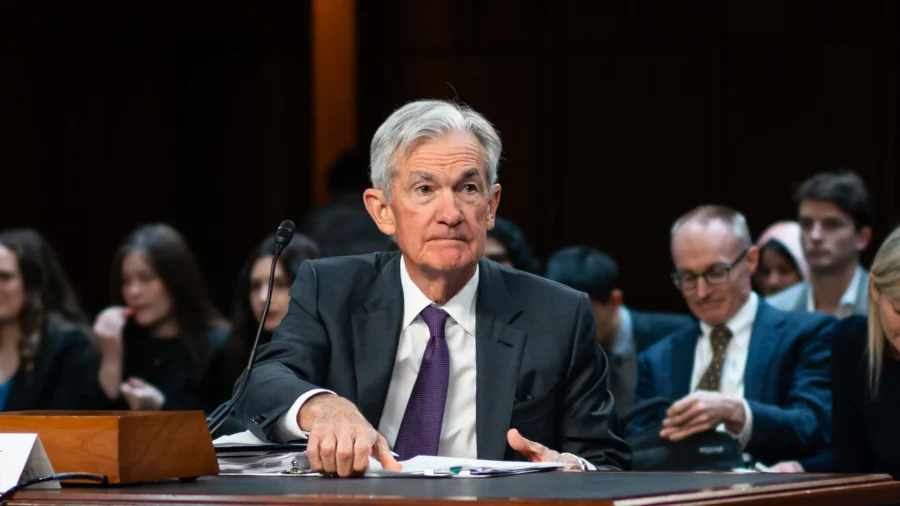
The Federal Reserve is expected to cut interest rates again when officials meet this week for the Federal Open Market Committee's two-day policy meeting.
As monetary policymakers inch closer to the neutral rate—when interest rates are neither stimulative nor restrictive—the Fed is engaged in a balancing act: protect jobs and prevent a rekindling of the inflation flame.
Last month, officials restarted their easing cycle, following through on the year's first rate cut.
The decision would bring the benchmark federal funds rate—a key rate that influences business and household borrowing costs—to a new target range of 3.75 percent to 4 percent.
Since a rate cut is penciled in, Wall Street will be closely watching what is said at the post-meeting press conference on Oct. 29, Jay Woods, chief global strategist at Freedom Capital Markets, said.
"As the market tends to do, it is already focused on the next meeting," Woods said in a note emailed to The Epoch Times.
"As of now, the path for one more cut at the Fed’s final meeting in December seems possible, and investors are hoping the message from this meeting makes it appear even more probable."
The futures market suggests the odds of an end-of-year cut stand at 98 percent.
“There is no risk-free path for policy as we navigate the tension between our employment and inflation goals,” he said.
He also noted that the end of the institution’s three-year quantitative tightening program—a balance sheet reduction initiative—is looming.
Debate at the Fed
Should the Fed accelerate its campaign of rate cuts to account for the lag effect of monetary policy? Or is a slow-and-steady approach better, especially without key economic data?This is the debate that central bank officials are having in late 2025.
Ultimately, Goolsbee believes "the underlying economy can afford rates to come down over time, in a gradual basis, a fair amount from where they are now."
Citing growing risks to the labor market, Boston Fed President Susan Collins argued for further rate cuts. Even with more rate cuts ahead, Collins thinks monetary policy remains mildly restrictive.

Fed Governor Stephen Miran has repeatedly advocated for bringing the neutral rate more quickly.
Miran, who is on leave from the White House’s Council of Economic Advisers to temporarily serve at the Federal Reserve, says the next rate cut should be 50 basis points.
The lack of vital inflation and employment figures has made it more challenging to craft policy.
Policymakers and investors have been in the dark about broader economic conditions, relying on alternative private-sector measurements and regional central bank indicators to gauge the economy’s health.
The September jobs report was not published, and with the government shutdown about to enter its fifth week, the October nonfarm payrolls report might not be released either. Other metrics, such as weekly jobless claims, producer price inflation, and trade deficit, have not been issued either.
"Business surveys aren’t painting a particularly upbeat picture of the state of the economy, so like the market, we expect the Fed to cut rates next week and follow up with another 25bp cut in December."
To ensure the Social Security Administration can calculate cost-of-living adjustments, the Bureau of Labor Statistics distributed consumer inflation numbers for September.
The current climate—government shutdown, record high stock market, and trade strife—could make it tough for Powell to hint at another cut. But, Woods says, "the key is that he doesn’t rule it out entirely."
"He could easily take a more neutral stance as he has ammunition in the current shutdown," Woods said.
"It would make sense for him to state that as a data dependent body they will need more information before making any new decisions. That could scare the market, but it could also put more pressure on Washington to get a deal done to end the shutdown.”
The rate-setting committee will hold its meeting on Oct. 28 and 29.