


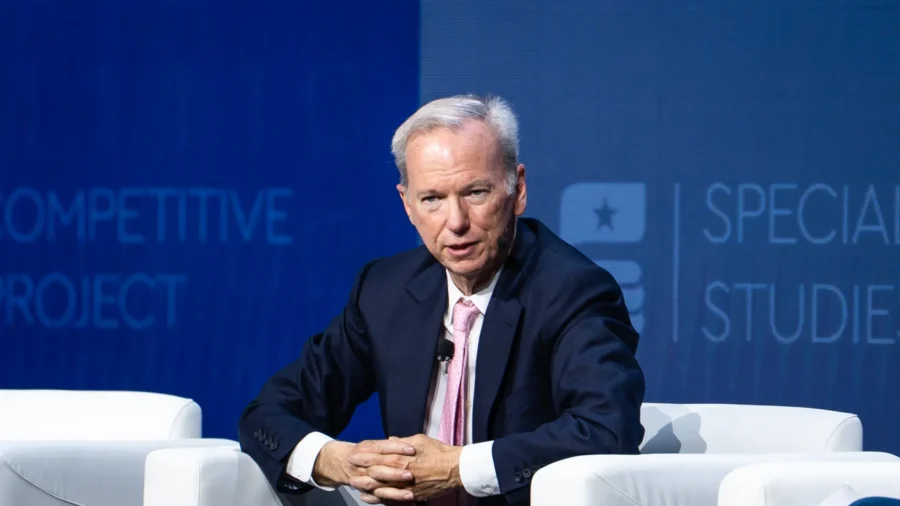
Thousands of students graduating from the University of Arizona booed former Google CEO Eric Schmidt for his comments on artificial intelligence (AI) during his commencement address on May 15.
Schmidt, who was head of the internet giant for a decade, spoke at length to approximately 9,000 students about the rise of the computer and the evolution of technology.
“The same platforms that gave everyone a voice, like you’re using now, also degraded the public square,” he said.
“They rewarded outrage. They amplified our worst instincts. They coarsen the way we speak to each other, and that way, and in the way that we treat each other, is in the essence of a society.”
He then likened the rise of AI to the impact of the computer, which was met with derision from the crowd.
“I know what many of you are feeling about that. I can hear you,” Schmidt responded to the frustrated crowd.
“There is a fear ... there is a fear in your generation that the future has already been written, that the machines are coming, that the jobs are evaporating, that the climate is breaking, that politics is fractured, and that you are inheriting a mess that you did not create, and I understand that fear. It’s rational.”
He encouraged students to “find a way to say yes” to artificial intelligence, saying that it was a “rocketship” that would change the world.
The University of Arizona's announcement of Schmidt as the commencement speaker called him a “leading architect in the era of artificial intelligence,” and said, “Few leaders have played a more defining role in shaping the future and advancing scientific frontiers.”
Additionally, concerns about the environmental impact of the technology and the outsourcing of jobs to artificial intelligence have disillusioned many people who are joining the workforce.
Schmidt pivoted to an attempt to encourage the graduating class by telling them they have the power to shape how AI develops, an assertion with which the students also voiced disapproval.
The former tech CEO urged the students to embrace engagement with artificial intelligence and be willing to have open discussions with those on opposite sides of the topic.
“If you’d let me make this point, please," Schmidt said amid boos from the crowd. “The point I’d like to make is: Choose a diversity of perspectives, including the perspective of the immigrant who has so often been the person who came to this country and made it better. America is at its best when we are the country that ambitious people want to come to. Let us not lose that.”
A similar scene took place at the University of Central Florida, where graduates booed Gloria Caulfield, vice president of strategic alliances at the Orlando-based Tavistock Development Company.
“The rise of artificial intelligence is the next industrial revolution,” Caulfield said during the May 8 commencement speech, before being drowned out by boos.
She acknowledged that her words “struck a chord,” and asked, “May I finish?” before continuing.
“Only a few years ago, AI was not a factor in our lives,” she said, which was met with cheers and fist pumps from the crowd. Caulfield called it a “bipolar topic,” and pressed on with her comments about the capabilities of artificial intelligence.