


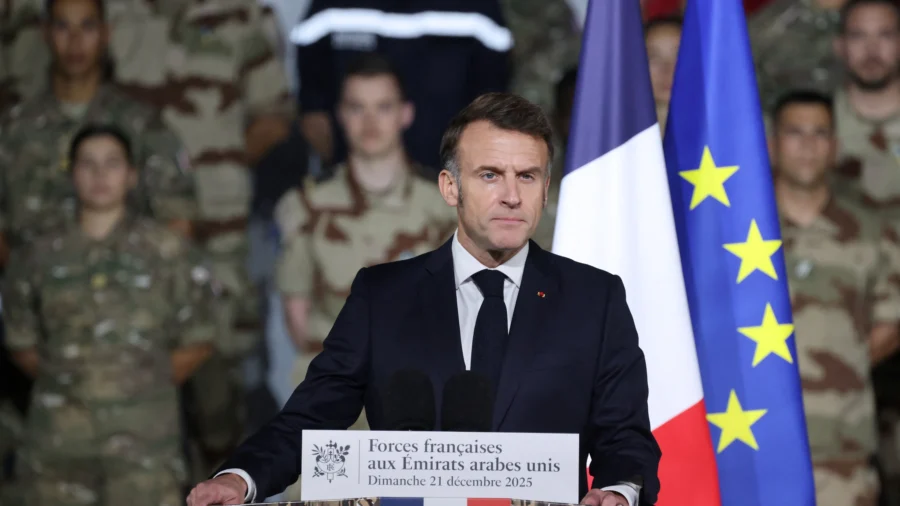
French President Emmanuel Macron confirmed on Dec. 21 plans to build a new nuclear-powered aircraft carrier to replace the ageing “Charles de Gaulle”, which entered service in 2001.
“In accordance with the last two military programming laws and after a thorough and meticulous review, I have decided to equip France with a new aircraft carrier,” Macron said.
He made the announcement during a speech to French troops stationed in Abu Dhabi, in the United Arab Emirates, near the Straight of Hormuz—a crucial chokepoint for global oil transportation.
The president said the decision to launch the major program was made that week. He said it will be built in France—promising to visit the shipyard in February—and that the project will benefit the French economy, with 800 suppliers involved.
“This new aircraft carrier will be a testament to the power of our nation: the power of industry and technology, power at the service of freedom on the seas and in the face of changing times, and stability also for the benefit of our strategic partner, the United Arab Emirates, with whom we maintain ties of profound trust,” Macron said.
According to the French Ministry of the Armed Forces and Veterans Affairs website, the new PA-NG craft will be powered by two K22 nuclear reactors and will be equipped with French Rafale M fighter jets.
The ministry says the new aircraft carrier will be able to engage in heavily armed, long-range air missions repeatedly and over extended periods of time, and at short notice.
The craft will be around 1,017 feet long—larger than the Charles de Gaulle, which is 856 feet in length. However, it would still be smaller than the “USS Gerald Ford” aircraft carrier, which is 1,100 feet and the world’s largest warship.
Increased Defense Spending
In response to new global security threats, France has been boosting its defense spending and strategic partnerships.On July 13, Macron announced an additional 6.5 billion euros ($7.6 billion) in defense funding in 2026 and 2027.
France is also developing strategic defense partnerships with its European allies.
The program, unveiled on Nov. 27, will open to men and women aged 18 and 19 and will see paid recruits receive training in weapons handling, field drills, and marching. After 10 months, participants could stay in the military, become a reservist, or return to civilian life.
Those in the program would only ever be deployed in France.
The French government expects 3,000 people to sign up in 2026, rising to 10,000 by 2030. Macron said he hopes that 50,000 young people will be signed up by 2036.