


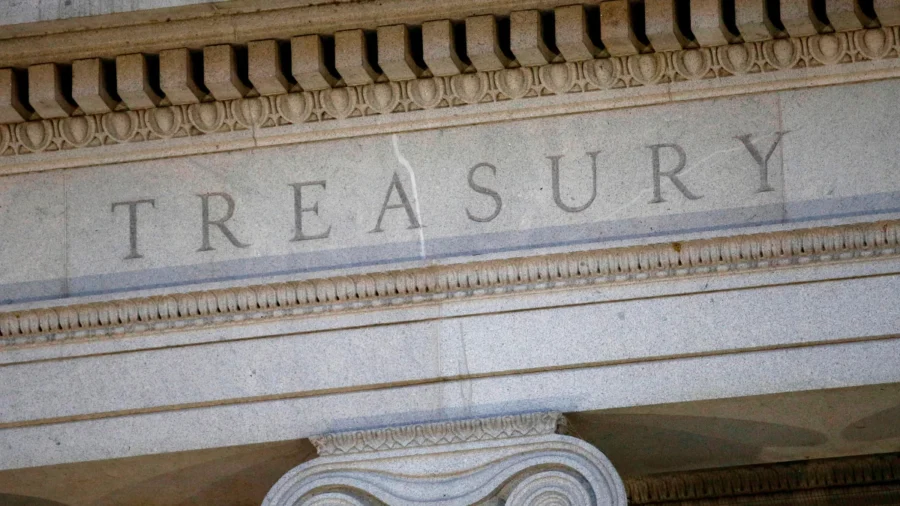
Government bonds from Tokyo to New York City extended losses on May 18 as rising oil prices linked to the Iran war continued to push inflation fears.
Benchmark 10-year U.S. Treasury yields jumped by as much as 3.6 basis points to their highest level since February 2025, at 4.63 percent in early May 18 trading.
The two-year yield, which is most sensitive to inflation and rate expectations, reached a 14-month high of 4.11 percent, while the 30-year U.S. Treasury yield hit a one-year high of 5.16 percent.
S&P 500 futures fell by 0.4 percent, and Nasdaq futures lost 0.5 percent in early trade. Japan’s Nikkei eased by 0.4 percent, having fallen by 2 percent last week, although that was from record highs. South Korean stocks fell by 2.1 percent.
The Treasury Department sold $25 billion of new 30-year bonds on May 13, with the auction yield reaching 5.05 percent.
Treasury bond yields represent the return that investors receive for lending to the U.S. government over different periods. They move in the opposite direction of prices, meaning that higher yields usually reflect falling bond prices or investors demanding a better return to buy the debt.
“The fact that we are now seeing data backing up inflationary fears that have been in the market since the Middle East conflict started, I think, is key,” said Nick Twidale, chief markets analyst at ATFX Global.
The yield on the latest issue of 10-year Japanese government bonds, the country’s benchmark long-term interest rate, briefly climbed to 2.8 percent in Tokyo trading on May 18, its highest level in 29 years, amid inflation concerns and worries about deteriorating public finances, Jiji Press reported on May 18.
Finance ministers from the G7 group of leading industrial nations will meet over the next two days to discuss the economic fallout from the conflict and volatility in global bond markets.
The meeting will also be attended by representatives from G7 central banks.
When asked whether bond markets were collapsing, French Finance Minister Roland Lescure said, “They’re undergoing a correction—I wouldn’t say they’re collapsing.”
“We are no longer in a period where public debt is not a subject,” he told reporters as he arrived at the meeting.
German central bank head Joachim Nagel said policymakers could do much to calm markets and give them a positive boost.
When asked on arrival whether she was worried by the bond sell-off, European Central Bank head Christine Lagarde told reporters, “I always worry, that’s my job.”
Bank of England interest rate-setter Megan Greene said central banks should not assume that the Iran war’s inflationary hit will be temporary.
“This is our third negative supply shock in five years,” Greene said at a Financial Times event on May 18. “We do have to worry about wage and price setting.
“Traditionally, you look through negative supply shocks, but I think when you have successive ones, actually, that’s outdated folklore and we shouldn’t be looking through them anymore.”
Fatih Birol, head of the International Energy Agency, said on May 18 that commercial oil inventories were depleting rapidly, with only a few weeks’ worth left due to the Iran war and the closure of the Strait of Hormuz to shipping.
Birol, who is participating in the G7 finance leaders meeting in Paris, told reporters that the release of strategic oil reserves had added 2.5 million barrels of oil per day to the market but that these reserves “are not endless.”
The 32-member International Energy Agency coordinated the largest-ever release of stocks from strategic reserves in March, agreeing to withdraw 400 million barrels to calm markets.
About 164 million barrels had been released by May 8, it said.