

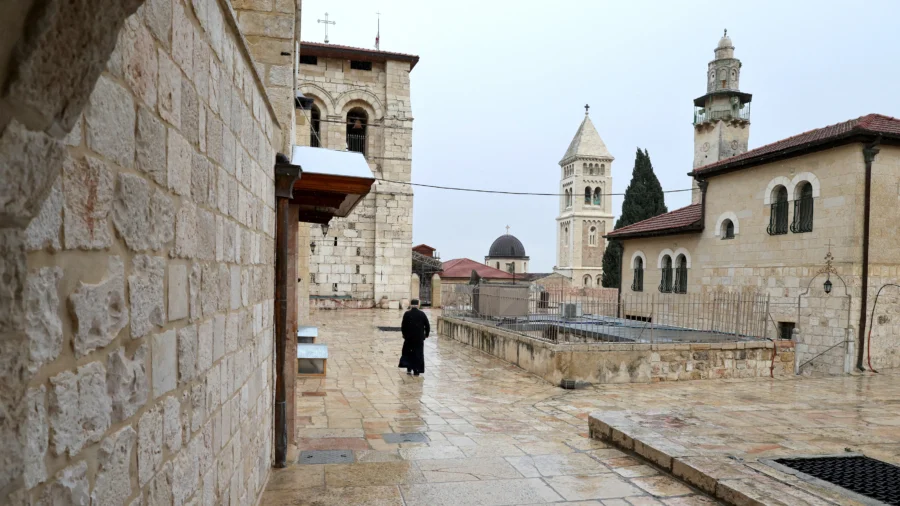
Israeli police blocked the Catholic cardinal of Jerusalem from marking Palm Sunday in the Church of the Holy Sepulchre, sparking criticism from global leaders and a subsequent reversal by Israeli officials.
Cardinal Pierbattista Pizzaballa and Friar Francesco Ielpo were prevented from entering the church, where they intended to celebrate a mass, according to a statement from the Latin Patriarchate of Jerusalem. The church is said to be built at the location of Jesus Christ’s crucifixion and resurrection.
Israeli police said they barred the cardinal’s entrance to the church over security concerns related to the U.S.–Israel war with Iran.
Cardinal Complains
Pizzaballa and Ielpo were en route to the Church of the Holy Sepulchre, "while proceeding privately and without any characteristics of a procession or ceremonial act, and were compelled to turn back,” according to a joint statement from the Latin Patriarchate of Jerusalem and Custody of the Holy Land.“As a result, and for the first time in centuries, the Heads of the Church were prevented from celebrating the Palm Sunday Mass at the Church of the Holy Sepulchre,” they stated.
The Patriarchate said that the incident set “is a grave precedent," and disregards "the sensibilities of billions of people around the world who, during this week, look to Jerusalem.”
Israeli police said in a March 29 post on X that, under Home Front Command directives, "life-saving restrictions apply to all holy sites in the Old City—for Jews, Christians, and Muslims alike."
"The Old City has been targeted by murderous missiles multiple times this month, alongside constant fire on residential areas. These threats do not discriminate between religions, and neither does our duty to protect you," Israeli police added.
Fragments from an Iranian cluster bomb fell on several of Jerusalem’s holiest sites on March 16, including the Church of the Holy Sepulchre.
"We are in active dialogue with religious leaders, including an upcoming meeting with the Patriarch, to examine solutions that balance freedom of worship with public safety."
Under guidelines issued by the Israel Defense Forces Home Front Command amid the war with Iran, gatherings of up to 50 people are permitted, provided that a shelter can be reached within the time available when a siren sounds.
International Criticism
White House press secretary Karoline Leavitt told reporters at a March 30 news conference that she had spoken with U.S. Secretary of State Marco Rubio, and they expressed their “concerns with Israel with respect to these holy sites” being closed.“We want worshipers to be able to access these holy sites. Of course, safety is a top priority, but we understand Israel is working on those security measures to reopen the sites throughout Holy Week, and that's something that we're appreciative of,” she added.
The Israeli police's move drew criticism from U.S. Ambassador to Israel Mike Huckabee, who called it "an unfortunate overreach already having major repercussions around the world," adding that it was "difficult to understand or justify."
"Home Front Command Guidelines restrict any gatherings to 50 people or less," he said. "The 4 representatives of the Catholic Church were well below that restriction."
The move also prompted condemnation from around the world, with Italian Prime Minister Giorgia Meloni saying it "constitutes an offense not only to believers but to all communities that recognise religious freedom."
Italian Foreign Affairs Minister Antonio Tajani said on X that he had summoned Israel's ambassador over the incident.
French President Emmanuel Macron condemned the Israeli police's decision, saying on X that it "adds to the worrying increase in violations of the status of the Holy Places in Jerusalem."
"The free exercise of worship in Jerusalem must be guaranteed for all religions," he added.
Other condemnations also came from the prime minister of Spain, the president of Poland, the Jordanian foreign ministry, and the European Union.
The Vatican has not commented directly on the incident, but Pope Leo said in his Palm Sunday mass that our “prayers are more than ever with the Christians of the Middle East, who are suffering the consequences of a brutal conflict and, in many cases, are unable to observe fully the liturgies of these holy days.”
In a separate homily at the same event in St Peter's Square, the Pope said that God "does not listen to the prayers of those who wage war, but rejects them."
Israel’s Response
Israeli Prime Minister Benjamin Netanyahu said in a March 30 post on X that he had instructed the relevant authorities to grant the cardinal full and immediate access to the church."Today, out of special concern for his safety, Cardinal Pizzaballa was asked to refrain from holding Mass at the Church of the Holy Sepulchre," he said.
"Even though I understand this concern, as soon as I learned about the incident with Cardinal Pizzaballa, I instructed the authorities to enable the Patriarch to hold services as he wishes."
Israeli President Isaac Herzog also called Cardinal Pizzaballa to express his "great sorrow over the incident," according to a press release from his office.
"President Herzog noted that the unfortunate incident stemmed from security concerns due to the continuous threat of missile attacks from the Iranian terror regime against the civilian population in Israel, following previous incidents of Iranian missiles that had fallen in the area of the Old City of Jerusalem in recent days," the statement read.
Herzog also "reaffirmed the State of Israel's unwavering commitment to freedom of religion for all faiths, as well as to upholding the status quo at the holy sites of Jerusalem."
Representatives from the police also met with Cardinal Pizzaballa on March 30, during which a "mutual framework has been established for upcoming Easter ceremonies," according to a post on X.
"Due to the complex security reality of Operation 'Roaring Lion,' ceremonies including the 'Holy Fire' will be held in a symbolic, limited format. This coordination ensures that freedom of worship is maintained alongside our shared, primary duty: the protection of human life," police said.
The Latin Patriarchate of Jerusalem said in a statement on March 30 that the issue had been “addressed and resolved in coordination with the relevant authorities.”
“We express our sincere gratitude to His Excellency Mr. Isaac Herzog, President of the State of Israel, for his prompt attention and valued intervention. We also extend our appreciation to the Heads of State and officials who acted swiftly to convey their firm positions, many of whom personally reached out to express their closeness and support,” it added, saying they also prayed and hoped for “an end to the tragic war affecting the region, mindful of the heavy consequences it has on all.”
According to Christian belief, Palm Sunday marks the day Jesus entered Jerusalem and signals the start of Holy Week, the most important week in the Christian calendar, which culminates with Easter.
Jerusalem's Old City would typically be busy at this time of year, with Roman Catholics passing through the massive wooden doors of the Holy Sepulchre.
However, this year, Christians, Muslims, and Jews have been unable to observe Easter, Ramadan, or Passover as usual due to police restrictions brought about as a result of the war.
Along with the barring of the Holy Sepulchre, the Al-Aqsa Mosque was largely empty during Ramadan, and few Jewish worshippers have visited the Western Wall, believed to be the last remnant of the Second Jewish Temple, as Passover approaches on April 1.
Elsewhere in Jerusalem, Palm Sunday Masses were held at the Syriac Latin Church, a Salesian monastery, and other sites with easy access to shelters. In an underground shelter near Jerusalem’s central bus station, Palm Sunday Mass was celebrated by the head of the St. James Vicariate for Hebrew speaking Catholics, with about 120 people attending.
In 2020, with Catholic churches in Jerusalem closed due to the COVID-19 pandemic, Pizzaballa announced that Palm Sunday celebrations at the Church of the Holy Sepulchre would be reduced and the traditional Palm Sunday procession would be omitted.