


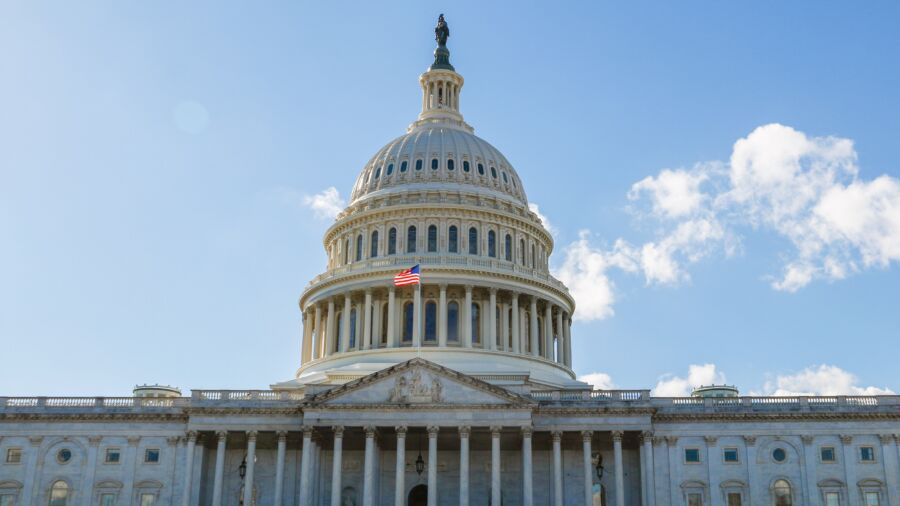
The House on March 27 overwhelmingly passed a bill to punish communist China for its forced organ harvesting from prisoners of conscience. The move marked the first non-symbolic legislative measure in the United States to counter the atrocity.
Rep. Chris Smith (R-N.J.), the principal sponsor of the bill, called attention to the penalties in the bill for those found to be involved in forced organ harvesting: a civil penalty of up to $250,000, and a criminal penalty of up to $1 million and 20 years in prison.
“It’s got real teeth. We’re not kidding,” Smith told The Epoch Times ahead of the floor vote. “This is an atrocity, this is a crime against humanity, and it’s a war crime, because this is a war on innocent people in China, and [Chinese leader] Xi Jinping is directly responsible, but those who willingly engage in this will be held responsible.

On the House floor, Democrat Rep. Susan Wild (Penn.), highlighted the annual reporting requirement in the bill, which she said would ensure the United States to “make an informed assessment regarding the magnitude and prevalence of this problem.”
“Given the ongoing genocide we cannot take Beijing at its word about what it is and is not doing,” she said. “We need to investigate and we need to verify.”
Haunting Memories
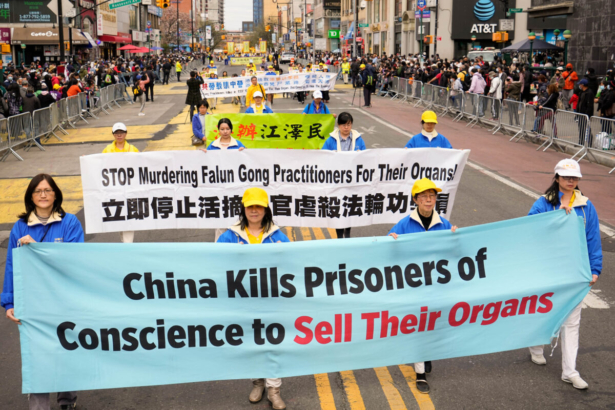
The news of the bill’s passage was heartening for many survivors of the regime’s persecution of their faith who have escaped to America for refuge, as in the case of Han Yu, an adherent of the persecuted faith group Falun Gong that’s been deemed as the primary victim group of the regime’s illicit organ trade.
Perceiving this popularity to be a threat to its control, the Chinese Communist Party (CCP) launched an elimination campaign in 1999, resulting in millions of adherents being detained, and an unknown number of deaths from slave labor, torture, and other abuses over the past 23 years.
A native of China’s capital Beijing, Han was 19 when she lost her father due to persecution in 2004, two years before the first reports of the regime’s secretive organ trade industry. More than another decade would come to pass before the issue became more widely recognized.
Extremely thin, with a face bruised green and purple, her father’s body lay cold in a forensic center room surrounded by dozens of uniformed officers.
There was tissue missing from under the man’s left eye. A long knife incision, sewn together with black thread, extended down from his throat. The police forced her out when she tried to unbutton his shirt to see where the stitches ended.
‘A Crime Never Seen Before’
Han for a long time struggled to accept the loss of her father. She dreamed of him often and would wake up in tears, she told The Epoch Times.The year 2006 was the first time multiple whistleblowers came to The Epoch Times to shed light on the dark scheme. In 2007, while surfing social media, she came across an article describing forced organ harvesting, and what happened to her father checked the box.
That night, Han cried for hours to the point she nearly fainted.
The story of Jiang Li, the daughter of a persecution victim in southwest China’s Xishanping Labor Camp, rings a similar tone.
Her father Jiang Xiqing, a retired official at a local tax bureau in the megacity Chongqing, was arrested after a house raid in May 2008—three months before Beijing hosted its first Olympics—and was given a one-year sentence to a labor camp without going through court.
He died in late January the following year, less than 24 hours after a family visit where he appeared healthy.
After seven hours in the freezer, the man’s face and chest remained warm, but when Jiang Li and other family members tried to call attention to the matter, police pushed them out of the morgue. Police cremated the body days later and threatened and harassed the family when they sought to get to the bottom of the matter, at one point telling Jiang Li to “name any price” to settle the case. A Chongqing procuratorate official, Zhou Bailin, told them that all of Jiang Xiqing’s organs had been “removed and turned into medical specimens.”
They never sought the Jiang family’s approval, nor was there any explanation.
‘Major Step Forward’
Torsten Trey, executive director of the medical ethics group Doctors Against Forced Organ Harvesting, welcomed the bill as a “major step forward” in helping to “raise critical awareness” about forced organ harvesting, but believes more measures are necessary to curb medical tourism to China.“The bill takes advantage of our legal system and applies existing mechanisms to demonetize or ban those who participated in these crimes against humanity,” he told The Epoch Times in an email.
What is missing, he said, is a requirement for all who enter the United States—be it legal and illegal immigrants, or U.S. citizens—to answer whether they have “‘imported’ a newly transplanted organ from countries that are known to procure organs through forced organ harvesting,” as well as the amount of money paid for the organs.
“Organ harvesting is a crime,” he said. While patients have the right to privacy, that privacy “should end at the crimes of forced organ harvesting: if Falun Gong practitioners or other prisoners of conscience have been killed for their organs in China, we should not cover up these crimes under the umbrella of healthcare privacy.”
Smith, the New Jersey congressman, said the bill could cover anyone who participates in forced organ harvesting, including patients who receive the organs.
“If there’s willful knowledge that is being stolen from a Falun Gong practitioner, or anyone else, then they could be held criminally and civilly liable,” he said.
“How do you know on a certain date, you’re going to have a liver all ready to go? That’s because they kill the individual in order to get that. They murdered them,” he added, referring to instances where Chinese hospitals have promised to deliver vital organs on a specified date—something impossible in voluntary organ donor systems.
Smith emphasized that there’s also a moral onus on Americans going to China for organ transplants to find out more about the source of the organs being used for the procedure.
Around the world, Israel, Taiwan, Italy, and Spain have already banned organ transplant tourism.
But if the Stop Forced Organ Harvesting Act becomes law, that would be one step toward that change, said Levi Browde, executive director of the Falun Dafa Information Center.
“With this bill, our Congress is joining lawmakers from several other countries who have passed laws aimed at stopping the horrific practice of murdering innocent people for their organs, and punishing those who continue to do so,” Browde said in a statement to The Epoch Times, while urging the Senate to pass the companion legislation.
“Despite all the economic and political pressure exerted by the CCP over the years, through this act, the U.S. government is officially, on the world stage, calling out the CCP for murdering people for organs.”