


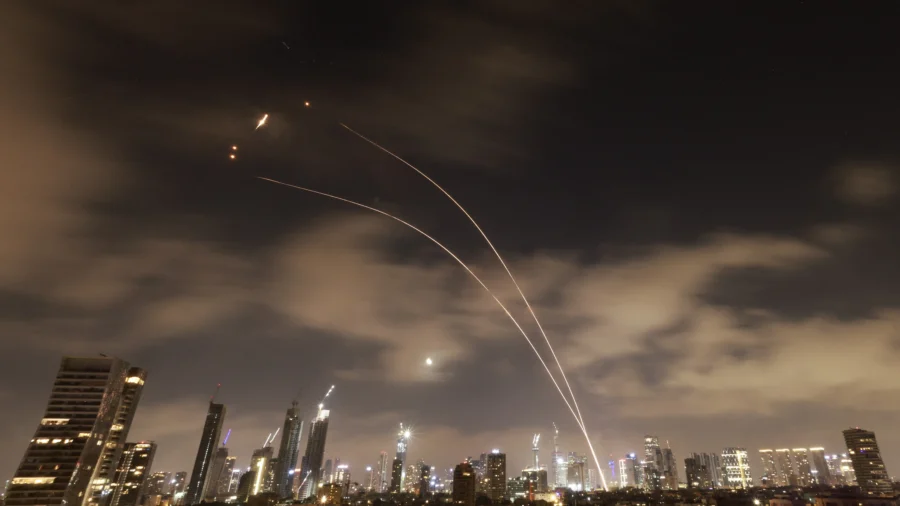
Israeli warplanes pounded Iran's capital overnight and into Wednesday as Iran launched a small barrage of missiles at Israel with no reports of casualties. An Iranian official warned Wednesday that any U.S. intervention in the conflict would risk “all-out war.”
Foreign Ministry spokesman Esmail Baghaei delivered the warning in an interview with Al Jazeera English, saying, “Any American intervention would be a recipe for an all-out war in the region.” He did not elaborate, but thousands of American troops are based in nearby countries within range of Iran's weapons.
The latest Israeli strikes hit a facility used to make uranium centrifuges and another that made missile components, the Israeli military said. It said it had intercepted 10 missiles overnight as Iran’s retaliatory barrages diminish.
As the U.S. sent warplanes to the Middle East, Trump made a series of statements about the conflict, including warning Supreme Leader Ayatollah Ali Khamenei that the United States knows where he is hiding but that there were no plans to kill him “at least not for now.”
Israel asserts its sweeping assault is necessary to prevent Iran from getting any closer to building an atomic weapon. The strikes have killed at least 224 people in Iran.
Iran has retaliated by launching some 400 missiles and hundreds of drones at Israel. So far, 24 people have been killed in Israel.
Israel Hammers Tehran
A major explosion could be heard around 5 a.m. in Tehran Wednesday morning, following other explosions that boomed earlier in the predawn darkness.Authorities in Iran offered no acknowledgement of the attacks, which has become increasingly common as the Israeli airstrike campaign has intensified since they began on Friday.
At least one strike appeared to target Tehran’s eastern neighborhood of Hakimiyeh, where the paramilitary Revolutionary Guard has an academy.
The Israelis earlier warned they could strike a neighborhood south of Mehrabad International Airport, which includes residential neighborhoods, military installations, pharmaceutical companies and industrial firms.
Israel also claimed that it had killed Iran’s Gen. Ali Shadmani, whom Israel described as the country’s most senior remaining military commander, in Tehran.
Trump Demands Iranian Surrender
Trump left the Group of Seven summit in Canada a day early to deal with the conflict between Israel and Iran, telling reporters: “I’m not looking at a cease-fire. We’re looking at better than a cease-fire.”When asked to explain, he said the United States wanted to see “a real end” to the conflict that could involve Iran “giving up entirely.” He added: “I’m not too much in the mood to negotiate.”
But he also indicated that diplomatic talks remained an option, and said he could send Vice President JD Vance and special envoy Steve Witkoff to meet with the Iranians.
Meanwhile, the United States is shifting military aircraft and warships into and around the Middle East to protect Israel from Iranian attacks and respond to Iran's threats to target U.S. military installations.
Satellite images analyzed Wednesday by The Associated Press appeared to show no vessels anchored off the headquarters of the U.S. Navy’s 5th Fleet in Bahrain. Dispersing ships is a common safety technique employed by navies around the world in times of trouble.
Iran Vows Further Attacks
Iran offered no immediate response to the president's posts, but the country’s military leaders vowed that Israel would soon see more attacks.“The operations carried out so far have been solely for the purpose of warning and deterrence,” Gen. Abdul Rahim Mousavi, the commander in chief of Iran’s army, said in a video. “The punishment operation will be carried out soon.”
Israel’s military warned the population to stay close to shelters as Iran fired new salvos of missiles Wednesday, but officials said most were intercepted and Israel's rescue services had no immediate reports of injuries. Sirens blared in southern Israel, including in the desert town of Dimona, the heart of Israel’s never-acknowledged nuclear arms program.
The U.S. State Department announced that the U.S. Embassy in Jerusalem will remain closed through Friday.
Shops Closed, Lines for Gas in Iran’s Capital
Trump warned on social media that “everyone should immediately evacuate Tehran," echoing an earlier Israeli military call for some 330,000 residents of a downtown neighborhood there to evacuate.Tehran is one of the largest cities in the Middle East, with around 10 million people, roughly equivalent to Israel's entire population. People have been fleeing since hostilities began.
Asked why he had urged the evacuation, Trump said: “I just want people to be safe.”
Downtown Tehran emptied out early Tuesday, with many shops shuttered, as well as the ancient Grand Bazaar, which has closed only in times of crisis, such as during the 2022 anti-government protests and the coronavirus pandemic.
Signs That Iran Is Restricting Access to Outside World
Iranian authorities appeared to be curbing the public's access to the outside world. Phone and internet service was disrupted, with landline phones unable to receive or dial international calls. NetBlocks, an internet monitoring group, reported that it had detected a significant drop in internet traffic from the country.Iran’s Cyber Security Command acknowledged the internet restrictions and in a statement carried by Iranian state television said the move was meant to stop enemies from “continuing to exploit infrastructure to carry out cyber and military operations."
Iran has restricted important communications tools in past nationwide protests and during the 1980s Iran–Iraq war.
International websites appeared to be blocked, but local websites were functioning, likely signaling that Iran had turned on the so-called “halal net,” its locally controlled version of the internet aimed at limiting what the public can see.
Iran's state TV on Tuesday urged the public to remove the messaging app WhatsApp from their cellphones, alleging without evidence that the app gathered user information to send to Israel.
Nuclear Agency Reports More Damage to Enrichment Site
The International Atomic Energy Agency said it believed that Israel’s first aerial attacks on Iran’s Natanz enrichment site had directly affected the facility’s underground centrifuge facility.Satellite imagery collected after Friday’s attacks showed “additional elements that indicate direct impacts on the underground enrichment halls,” the watchdog said.
The IAEA earlier reported that Israeli strikes had destroyed an above-ground enrichment hall at Natanz and knocked out electrical equipment that powered the facility, which is 220 kilometers (135 miles) southeast of Tehran.
Most of Iran's enrichment takes place underground to protect from airstrikes.
Israel has struck Natanz repeatedly and claims to have hurt its underground facilities, which experts assess contain 10,000 centrifuges that enrich uranium up to 60 percent.
Iran maintains its nuclear program is peaceful, and the U.S. and others have assessed that Tehran has not had an organized effort to pursue a nuclear weapon since 2003. But the IAEA has repeatedly warned that the country has enough enriched uranium to make several nuclear bombs should it choose to do so.
While Netanyahu claimed Monday that Israeli strikes on Iran's nuclear sites have set the country's nuclear program back a “very, very long time," Israel has not been able to reach Iran’s Fordo uranium enrichment facility, which is built deep into a mountainside.
Hitting Fordo would likely require the United States's own B-2 stealth bombers to drop bunker-busting bombs. The 30,000-pound (14,000-kilogram) GBU-57 Massive Ordnance Penetrator uses its weight and sheer kinetic force to reach deeply buried targets.