


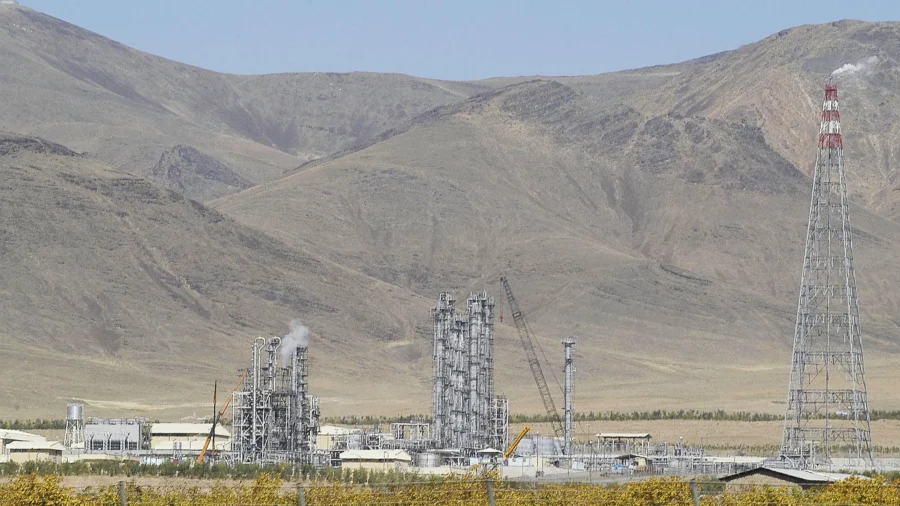
Iran’s heavy water production plant (HWPP) at Khondab has been “severely damaged” and is no longer operational following a strike, according to the U.N. nuclear watchdog.
In a March 29 post on X, the International Atomic Energy Agency (IAEA) said that, based on independent analysis of satellite imagery and its knowledge of the site, it had confirmed that the facility targeted on March 27 had sustained extensive damage and “is no longer operational.”
“The installation contains no declared nuclear material,” the agency added.
The Khondab site, near the central Iranian city of Arak, is part of a long-running nuclear project under international scrutiny.
The plant produces heavy water intended for use in the IR-40 reactor, helping to sustain the nuclear reaction.
The plant has operated in the past and is capable of producing heavy water; however, it’s not enough to power the reactor, according to the Nuclear Threat Initiative (NTI).
“Assuming a maximum annual production capacity of 16 tons per year and intermittent operation for approximately five years, it seems unlikely that the HWPP has yet produced enough heavy water to moderate the IR-40 reactor,” it said.
In a report last year, the IAEA said it had “lost continuity of knowledge” over Iran’s heavy water production and inventory, which it said “will not be possible to restore.”
Heavy water reactors use natural uranium as fuel and can, in certain configurations, produce plutonium as a byproduct, an alternative pathway to nuclear weapons.
The Khondab HWPP supplies the reactor with heavy water, which slows neutrons and allows the nuclear reaction to continue.
In an X post on March 30, the Israeli air force said that in a series of attack sorties in Tehran over the past two days, approximately “40 sites and production and research industries for weapons were attacked.”
Israeli military graphics released alongside the strike claims identified key elements of Iran’s nuclear infrastructure, including underground enrichment sites at Natanz and Fordow, and production and research facilities at Isfahan.
Iran’s foreign ministry spokesman, Esmael Baghaei, told Iran Press, a news agency affiliated with Iran’s state broadcaster IRIB, on March 30 that “the actions taken by the U.S. and the Israeli regime against nuclear facilities in Boushehr, Arak, and Isfahan are crimes.”
In addition to the soldiers, the vessel brings amphibious assault capabilities, strike fighters, and transport aircraft to the region.
While U.S. forces are being stationed in the Middle East, there is no guarantee that a ground invasion will happen. Secretary of State Marco Rubio said on Friday that the military deployment was a precautionary measure to prepare for unforeseen contingencies.
The resolution, backed by France, the UK, and Germany (the E3), along with the United States, is expected to bring the issue before the U.N. Security Council. Iran immediately responded by announcing plans to establish a new enrichment facility “in a secure location.”
In a quarterly report published in November 2024, the IAEA said Iran—which denies it is seeking to build nuclear weapons—had continued to enrich uranium up to a 60 percent concentration of U-235. Uranium must be enriched to at least 90 percent to be considered weapons-grade.