


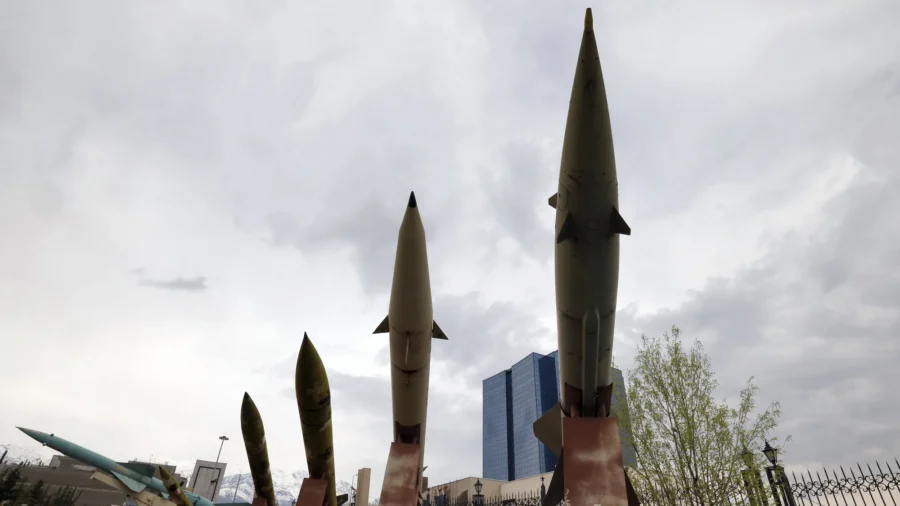
DUBAI, United Arab Emirates—Iran's Revolutionary Guard navy on Saturday warned that any attack on Iranian oil tankers or commercial vessels would be met with a “heavy assault” on one of the U.S. bases in the region and enemy ships, even as a tenuous ceasefire appeared to be holding.
Iranian state TV reported the warning a day after the United States struck two Iranian oil tankers. The U.S. military said the tankers were trying to breach its blockade of Iran’s ports.
Meanwhile Bahrain, which hosts the U.S. Navy’s regional headquarters, said it arrested dozens of people it alleged had links to Iran’s Revolutionary Guard.
Bahrain Says Arrests Linked to Guard Funding Attempt
Bahrain said it had arrested 41 people it said are part of a group affiliated with the Revolutionary Guard. The interior ministry said investigations confirmed they were in contact with the Guard and collected funds “with the aim of sending them to Iran” to support its "terrorist operations.”Iran issued a warning to Bahrain: “Siding with the U.S.-backed resolution will bring severe consequences. The Strait of Hormuz is a vital lifeline; do not risk closing it on yourselves FOREVER," Ebrahim Azizi, head of the national security commission of Iran’s parliament, said on social media.
Iran has mostly blocked the critical waterway for global energy since the United States and Israel launched the war on Feb. 28, causing a global spike in fuel prices and rattling world markets.
Britain Deploys Warship to Middle East
Britain’s defense ministry said it was deploying a warship to the Middle East to join a potential mission to protect commercial ships in the Strait of Hormuz once hostilities end.The ministry said the HMS Dragon will “preposition” in the region, ready to join a U.K.- and French-led security plan. France announced this week it was moving its aircraft carrier strike group into the Red Sea in preparation.
Diplomacy Continues ‘Day and Night’
U.S. President Donald Trump has reiterated threats to resume full-scale bombing if Iran doesn’t accept an agreement to reopen the strait and roll back its nuclear program. On Friday, Iranian foreign ministry spokesperson Esmail Baghaei said the country was not paying attention to “deadlines,” according to state-run IRNA.Diplomacy continues. Pakistani Prime Minister Shehbaz Sharif said his country has been in contact with the United States and Iran “day and night” in an effort to extend the ceasefire and reach a peace deal.
Russia’s foreign ministry said that it, as well as Saudi Arabia, was calling for diplomatic efforts to reach a “sustainable, long-term agreement” to end the war.
Separately, Putin told reporters in Moscow that taking enriched uranium from Iran to help negotiate a settlement would allow everyone to see “how much of it there is, and where it is located,” and “all of this would be placed under the control of the IAEA,” the U.N. nuclear watchdog.
Egyptian and Qatari top diplomats reiterated that diplomacy is the sole path to a solution, according to a readout of a phone call between the two foreign ministers.
Still publicly unseen and unheard since the war began is Iran's new Supreme Leader Mojtaba Khamenei, fueling speculation about his status.
On Friday, a top Iranian official said Khamenei was in “complete health” and eventually would appear in public. Mazaher Hosseini, affiliated with the office of Iran’s late supreme leader, Ayatollah Ali Khamenei, who was killed at the start of the war, made the comment at a pro-government gathering. Hosseini said Mojtaba, Khamenei's son, had knee and back injuries in the war’s opening attacks but they’ve largely healed.