


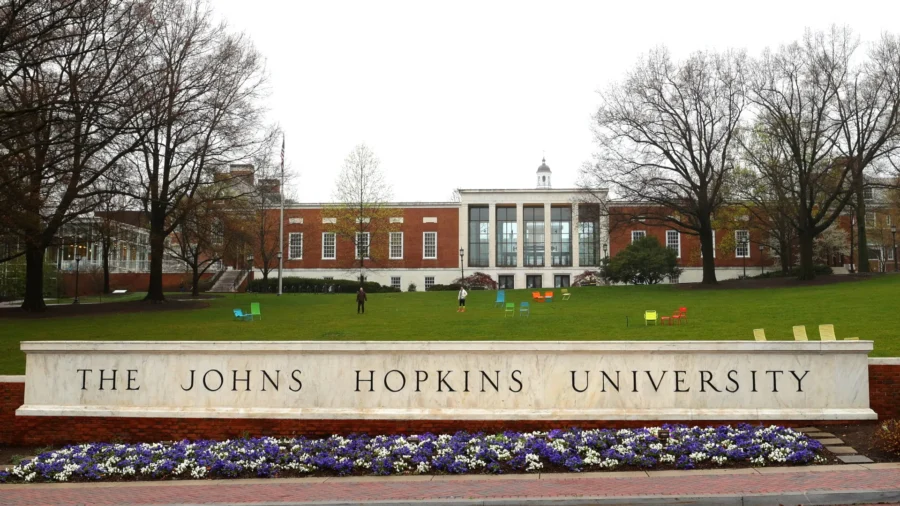
Johns Hopkins University will eliminate tuition for undergraduate students from families earning less than $200,000 a year, starting next year, university officials said.
"This means students from a majority of American families, including middle-class families earning above the national median household income of $87,730, can attend Hopkins at no expense," university officials said, citing U.S. Census data.
Furthermore, families earning up to $250,000 will continue to qualify for significant aid, and even those with annual incomes exceeding $250,000 may still qualify, especially when they have multiple children in college simultaneously, according to the announcement.
The new financial aid levels will apply to qualified students currently enrolled in the spring 2026 semester, as well as to incoming students for the 2026–2027 academic year.
In a message to the campus community, Johns Hopkins President Ron Daniels emphasized that the money needed for the changes will be entirely drawn from funds already dedicated to financial aid.
According to Daniels, Johns Hopkins' financial aid capacity has grown substantially since Michael Bloomberg, an alumnus and former mayor of New York City, donated $1.8 billion to the university in 2018—the largest gift ever made to an American institution of higher education at the time.
Since then, the share of Hopkins undergraduates from lower-income households has risen from 15.4 percent in 2018 to 24.1 percent in 2025, the highest in the university’s history.
"We are in their collective debt."
With Thursday's announcement, Johns Hopkins becomes the latest addition to a growing list of private and selective universities offering tuition guarantees for middle- and lower-income families.
Over the past year, several institutions have introduced new or expanded their existing tuition-free programs, including Carnegie Mellon University, Emory University, Harvard University, the Massachusetts Institute of Technology, Reed College, Tufts University, and Wake Forest University.
Costs are lower at public institutions, where the average sticker price is $31,880 for out-of-state students and $11,950 for in-state students.