


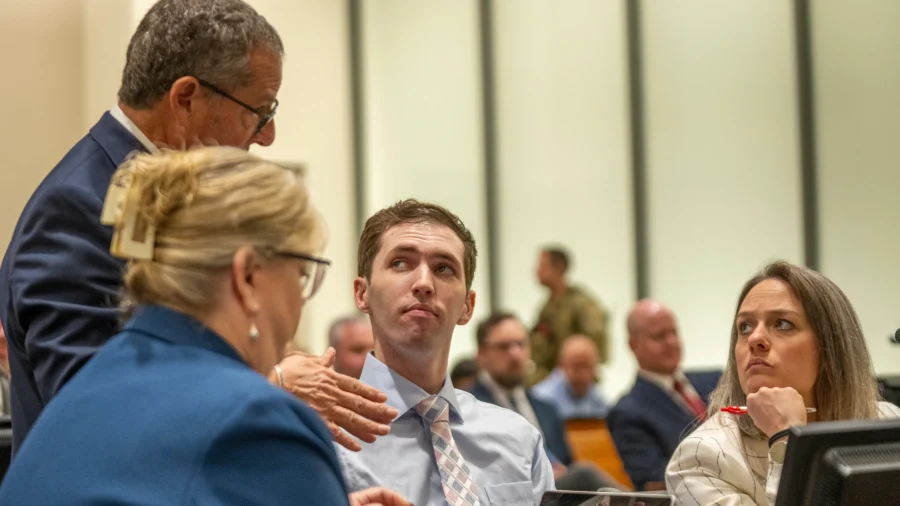
A Utah Judge will continue to allow cameras in the courtroom in the Charlie Kirk murder trial, but granted the defense’s motion to delay a preliminary hearing in the case until July.
In a video hearing on May 8, Utah Fourth District Court Judge Tony Graf, Jr., denied the defense motion to categorically prohibit any electronic media coverage going forward, saying they had not shown that “such a ban on media coverage for all proceedings in this case is allowed by Utah law.”
Media organizations, prosecutors, and Kirk’s widow, Erika Kirk, support allowing cameras in the courtroom, arguing the best way to guard against misinformation is transparency.
However, the judge said that restricting or suspending electronic media coverage could be considered on a case-by-case basis. He ruled that media outlets must request electronic media coverage of court proceedings at least 14 days in advance. If a party seeks to suspend or restrict electronic media coverage of a core proceeding, the party must file a motion addressing the “particular circumstances” within 10 days of the proceedings.
Livestreaming by the media already caused frustration for Graf previously, when the livestream had to be stopped, and the camera was relocated when it was discovered the video showed the defendant’s shackles, which is a violation of courtroom decorum.
Graf said during the video hearing on Friday that the court has taken steps “to abate threats to the fairness of these proceedings.”
“The court has issued a robust decorum order to manage the proceedings in a pretrial publicity order to prevent statements from attorneys involved in the case from potentially prejudicing the jury pool,” Graf said.
Graf said the court has positioned the video camera at the back of the courtroom, which has minimized, if not entirely mitigated, the potential for media to capture conversations at the council's tables and documents on the council's computer screens.
He granted the defendant’s motion to postpone a preliminary evidentiary hearing, rescheduling it for July 6–10 “in order to protect the defendant's constitutional rights while minimizing unnecessary delay in preserving the fair and impartial administration of justice.”
The man accused of killing Kirk, Tyler Robinson, appeared in court on April 17 as part of an evidentiary hearing and at the virtual hearing. Robinson, 23, has not yet entered a plea.
The court heard expert testimony at the April hearing on whether the case should be recorded by the media, following previous unverified reports that Robinson confessed to Kirk’s killing during an appearance in the courtroom on Dec. 11, 2025.
The defendant’s attorney previously filed claims that biased coverage is tainting potential jurors in the aggravated murder case.
The conversation with his attorney was inaudible, but a New York Post story cited a “lip-reading analysis” claim that Robinson allegedly said, “I think about the shooting daily.”
His attorneys wrote in their request to bar cameras: “The predominant purpose being served by the live stream coverage has not been the educational reporting of the court proceedings, but rather advertising profit, sensationalism, political agendas, and, most prominently, the vilification of Mr. Robinson.”
The Utah State Court code Rule 4-401.01 says there is a “presumption that electronic media coverage by a news reporter shall be permitted in public proceedings” when the purpose of the coverage is to report to the public.
However, that coverage can be prohibited or restricted for several reasons, including if a judge finds there is a reasonable likelihood the coverage will impact parties’ right to fair proceeding, jeopardize safety, or “create adverse effects greater than those caused by media coverage without recording or transmitting images or sound.”
Prosecutors are seeking the death penalty if Robinson is convicted in the Sept. 10 killing of Kirk.
The 31-year-old conservative commentator was shot before thousands of witnesses in a widely recorded incident when he was speaking at an event on the campus of Utah Valley University in Orem.
Prosecutors assert that DNA consistent with Robinson was found on the trigger of the rifle believed to have been used in the shooting, as well as bullet casings and two unfired cartridges, and a towel used to wrap the rifle.
In Robinson’s defense, attorneys note that forensic reports show DNA from multiple people on at least some of the items and are now pushing for access to the digitized data as part of discovery before the preliminary hearing. The defense asked for a four-month delay.