


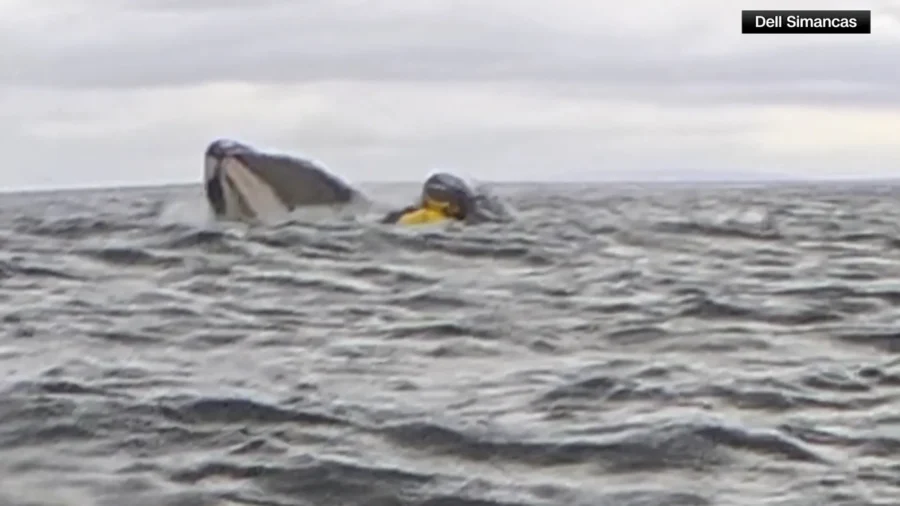
A Chilean kayaker had the fright of his life when a humpback whale briefly swallowed him off the coast of Patagonia before quickly releasing him unharmed. The incident, caught on camera, quickly went viral.
The event happened on Saturday, when Adrián Simancas was kayaking with his father, Dell, in Bahía El Águila near the San Isidro Lighthouse in the Strait of Magellan. Suddenly a humpback whale surfaced, engulfing Adrián and his yellow kayak.
Roughly a dozen yards away, the father was filming his son while this happened.
A few seconds later, Ardrián resurfaced, followed by his yellow kayak an instant later.
“Stay calm, stay calm,” Dell can be heard saying after his son was released from the whale’s mouth.
A third person on board the father’s kayak kept filming as Adrián peddled towards them while holding on to his overturned kayak.
“At first I thought I had died,” Adrián told The Associated Press when asked what went through his head when he disappeared into the animal’s mouth. “I thought it had already eaten me, that it had swallowed me.”
He described an initial feeling of “terror,” but explained that his real fear set in only after resurfacing, realizing the predicament they were in.
“When I came up and started floating, I was scared that something might happen to my father too, that we wouldn’t reach the shore in time, or that I would get hypothermia,” Adrián said.
Fortunately, the animal soon lost interest and the group was able to reach shore safely with no injuries.
Adrián said his first thought was that he had been attacked by a killer whale.
“We had been talking about orcas shortly before, so I had that in my head,” he said.
“I understood that, of course, it was probably out of curiosity that the whale had approached me, or maybe to communicate something,” Adrián said.
The Strait of Magellan is a popular tourist destination on the Chilean side of Patagonia, known for adventure activities.
Located about 1,600 miles south of Santiago, Chile’s capital, at the southern tip of South America, the strait is an important natural passage between the Atlantic and Pacific oceans.
Because of its proximity to the South Pole, the strait’s frigid waters pose a challenge for sailors, swimmers, and explorers who attempt to cross it.
Although it’s currently summer in the Southern Hemisphere, temperatures in the region remain cool, with minimums dropping to 39 degrees Fahrenheit and highs rarely exceeding 68 degrees Fahrenheit.