


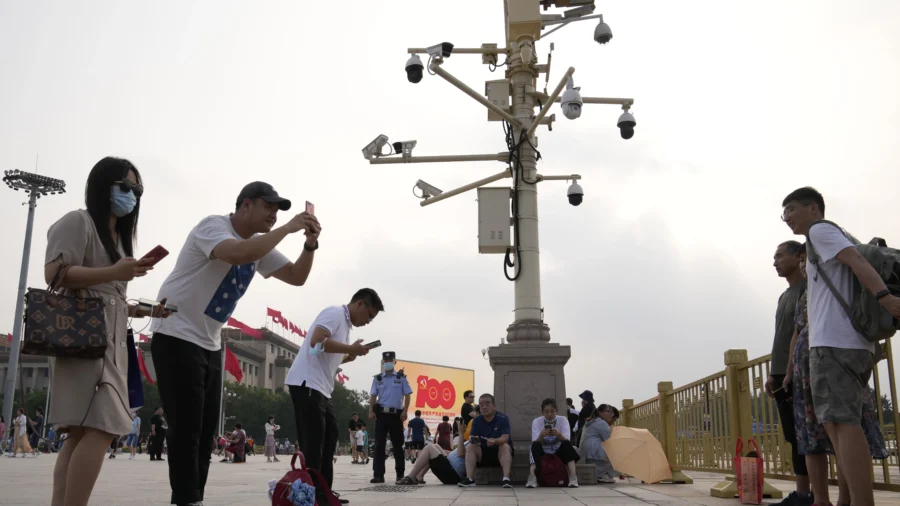
The moment a foreigner enters China, he or she might have already been monitored.
This tracking has been confirmed by a massive surveillance system established by the Chinese Communist Party (CCP), known as the Dynamic Control Platform for Overseas Personnel.
Among them, foreign journalists and other "sensitive individuals" are designated as primary targets for surveillance.
Sophia Yan, a senior foreign correspondent for The Telegraph who was stationed in China for a decade, discovered her own personal profile within this database.
Yan said that her file included her photo, the country of origin, her employer, her name in both English and Chinese, date of birth, citizenship, passport number, and her Chinese mobile number.
On the far right of her record, a specific column marked her as "trackable."
"When you click into that, that's when you get to see all the bits of data of where I was picked up and found somewhere in China and clocked into the database," Yan said.
She described the details in her records as "really minute." For instance, she was flagged 78 times at one specific intersection, while other data points came from cameras at supermarket entrances and various subway stations. "I mean, it's very, very specific. It's really fascinating and a little bit creepy."
Furthermore, the system includes a social-mapping feature that charts connections between individuals.
"You can see who knows each other, who are classmates, who are colleagues, if they live in the same neighborhood, if they live in the same block, if they've been spotted on camera together even," she said.
Apart from foreign journalists, the platform focuses on specific groups, including citizens of the "Five Eyes" alliance (Australia, Canada, New Zealand, the United Kingdom, and the United States). The system monitors the exact distribution of these citizens within specific Chinese cities, down to the neighborhood block level.
Additionally, data on Russians, Ukrainians, Belarusians, and Uyghurs are specially analyzed. Other filter categories embedded in the backend include "fugitives," journalists, tourists, and individuals traveling from Hong Kong, Macau, or Taiwan.
NetAskari suggests the system's development dates back to 2021, judging by its copyright stamps, though the bulk of its tracking logs are from 2023. At present, it remains uncertain if the platform is fully operational or still in its testing phase.
'Big Brother Is Watching'
The CCP’s pervasive surveillance network has significantly heightened vigilance among foreign visitors. During President Donald Trump’s recent visit to Beijing, accompanying personnel were told to drastically elevate their security protocols.Security protocols strictly prohibited connecting to hotel Wi-Fi networks and warned against using local charging stations in order to erase any digital footprint.
Bret Baier, the political reporter for Fox News, shared his firsthand experience while anchoring a broadcast from Beijing during the presidential visit. Observing the volume of surveillance infrastructure, Baier referenced George Orwell’s dystopian classic 1984, saying, "Big Brother is watching."
"There are literally cameras everywhere in Beijing. We are outside the Haidian station and I can count at least 20 on this corner," Bair said. He noted that another 1,500 cameras had been added that year alone in Beijing.
Baier mentioned an anecdote about his driver. After the driver parked illegally for a mere two minutes, he was caught on camera and a traffic fine notification of approximately $40 was instantly delivered to his phone.
Beyond the strict monitoring of incomers, the CCP blocked critical independent media from entering the country entirely.
Multiple American journalists scheduled to cover Trump’s visit were denied visas by the CCP. Among those barred were The Epoch Times White House correspondent Travis Gillmore, NTD Television reporter Mari Otsu, and photojournalist Lei Chen.
Both media are known for their long-term, rigorous reporting on sensitive topics in China, including human rights abuses, religious persecution, and forced organ harvesting.