


China’s industrial policy blueprint for building sectoral superstars in biotech and automobiles has Washington worried that the United States is falling behind.
“At the time, the idea of China producing a technology on par with the iPhone seemed very far-fetched, yet fast forward a decade, here we are. Companies like Huawei, ZTE, Xiaomi are not just competing, but they're shaping the global tech industry and beyond,” he said. “[China] is positioning itself to lead.”
The USCC is a bipartisan, congressional commission established by Congress in 2000. Its purpose is to monitor, investigate, and report on the national security and economic implications of the U.S.–China relationship. It holds roughly six hearings a year. The recent hearing focused on the rivalry between the world’s top two economic superpowers.
China Commission Asks 'Who Is Winning?'
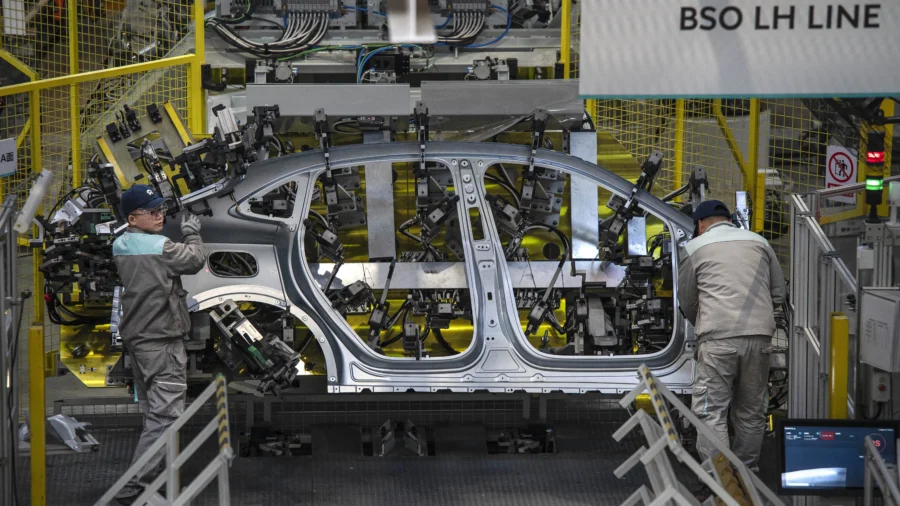
The Made in China 2025 policy launched in 2015. The document laid out goals for China’s manufacturing economy for the next 10 years, with a focus on renewable energy technologies, reduced foreign dependence, and creating global corporate brands that can become household names alongside South Korean, Japanese, and Western brands.Temu and Shein were the most downloaded retail apps in the United States in 2024, according to the Sensor Tower State of Mobile 2025 survey.
“Beijing is using industry to overtake and to overpower the United States. This is the ambition in Made in China 2025. ... The stakes for the U.S. are enormous,” said Emily de La Bruyère, co-founder of Horizon Advisory, a business intelligence firm. She took part in the commission hearing last week.
“Should the CCP realize its ambitions, the U.S. industrial and defense industrial bases will become entirely reliant on China. ... Beijing will be able to shape the American political and social system that depends on and is influenced by markets,” she said in her opening remarks, adding that Washington has mostly played defense against China or tried to out-subsidize China in programs like the CHIPS Act and the Inflation Reduction Act, signed into law by former President Joe Biden. She said it will be hard for Washington to out-subsidize China.
Commission member Aaron Frieberg, a Princeton University professor of international relations and a senior fellow at the American Enterprise Institute, raised concerns others may have about removing China from the international trading system.
“It's going to drive up costs. We can’t just do without China suddenly. We're highly dependent on them for all kinds of intermediate goods,” Frieberg said.
Reva Price, chairwoman of the commission, asked who was winning, China or the United States.
“Who is doing a lot of the winning right now, continuously, is China. However, I do believe that the United States is still ahead,” said Tim Khang, director of global intelligence at Strider Technologies based in South Jordan, Utah.
Hanna Dohmen, research analyst at Georgetown University’s Center for Security and Emerging Technology, told the commission she thought the United States was still ahead on computer chips, “but we are buying time. ... [I’d say we are] currently winning, but it's a window of opportunity that we need to take advantage of.”
In November, the U.S. Department of Justice charged Xiao Zhang, a top executive at Shanghai-based Pinestone Asset Management, with stealing proprietary information from his former employer, Arrowstreet Capital, a Boston-based investment firm.