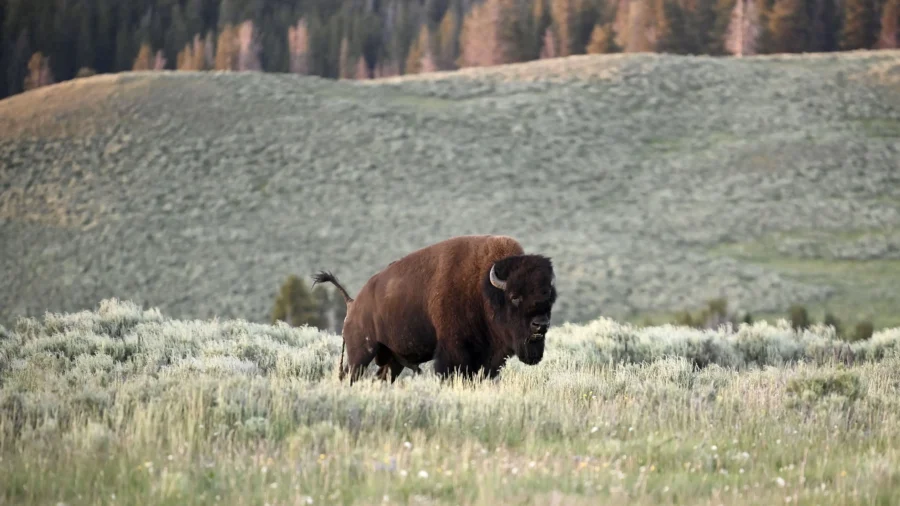
A 30-year-old man from Randolph, New Jersey, was gored by a bison after approaching too close to the massive animal while with a tour group in the Upper Geyser Basin region near Old Faithful in Yellowstone National Park, according to the National Park Service (NPS).
First responders treated and transported him for minor injuries after the event occurred at 9:45 a.m. on Tuesday. “The incident is currently under investigation, and no further details are available at this time,” NPS stated.
This is the second Yellowstone bison attack in 2025. The first recorded attack this year was also a goring with minor injuries, according to
NPS. The incident occurred when a 47-year-old man from Cape Coral, Florida, approached too near a bison on May 4.
In its
press release and in
educational pages, the National Park Service reminds visitors to stay at least two bus lengths away from park wildlife, such as bison and elk, and at least a football field’s length away from apex predators, such as wolves, cougars, and bears. NPS states that bison have injured more people in Yellowstone than any other animal. In addition to two this year, the park reported two bison goring
incidents in 2024 and one in
2023. In
2022, two visitors to Yellowstone were gored within three days of each other.
Although the large, wooly beasts can be docile in appearance they will defend their space when threatened and can run three times faster than humans. Bison are able to reach speeds of 35 mph and can weigh upwards of 2,000 pounds, generating a potentially devastating momentum when charging. Adding to the peril, both male and female bison have horns. Despite their mass, the protected animals are agile and can turn quickly.
The
2023 attack was one of the more serious recorded attacks of bison in recent times. The park reports that a 47-year-old female was evacuated by helicopter after sustaining injuries while walking with another individual and encountering two bison, which the pair then attempted to walk away from.
According to a
GoFundMe site created July 17, 2023, Chris Whitehill reached out for financial help following a Yellowstone bison attack that injured his fiancée, Amber Harris. Whitehill writes that Harris was “hit by a bison and has suffered severe fractures in her back.” In an Aug. 30, 2023, update “the ultimate physician,” namely “The Lord who heals” is credited with her recovery without spinal fusion, a surgery which would have placed permanent metal screws and rods in her back. It states that in the sixth week after the attack she was cleared for physical therapy.
Less details are available for the other serious attack in recent years, which was reported in an NPS
news release from June 3, 2024, and which also resulted in a helicopter evacuation. An 83-year old woman was attacked by a bison that “lifted her about a foot off the ground with its horns,” according to the National Park Service, which stated the bison was “defending its space.”
While unpredictable, a few indicators among many that could possibly warn a tourist that a bison may become aggressive include a lifted tail or the presence of young calves nearby. The park service mentioned on its
website that young bison calves, called “red dogs,” are born between March and May. While it is currently the season for young bison offspring to be with their herds, it is unknown if the tour group approached any bison with calves nearby.
With the most pure genes of any North American bison herd, the Yellowstone bison can be traced directly to southern Asia. The park service explains that this lineage was possible due to the Pliocene Epoch land bridge, which connected Asia with North America around 400,000 years ago. While tourists find the Yellowstone bison herd fascinating, the park
urges visitors to “love them from a distance.”