


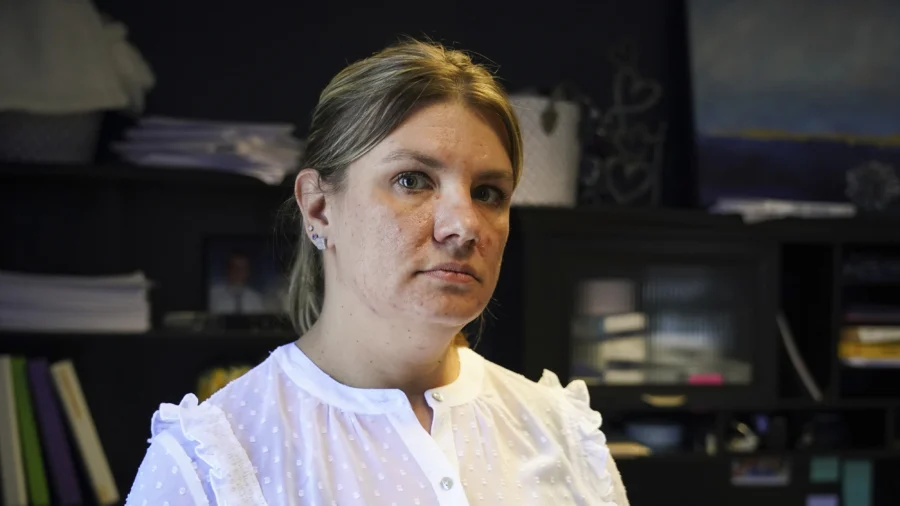
Aimee Bock, 45, will spend nearly 42 years in prison for playing what prosecutors called a “central” role in the nation’s largest COVID-19 pandemic scam, which raked in $242 million and resulted in dozens of indictments, many against Somalis. The case touched off lasting ripple effects not only in Minnesota, but also nationwide, prosecutors said.
Bock had been the leader of a nonprofit called Feeding Our Future (FOF), which prosecutors said “operated like a cash pipeline” by tapping into the federal Child Nutrition Program meant to feed children.
A federal jury convicted Bock and codefendant Salim Said in March 2025 after a six-week trial. Said has not yet been sentenced.
Bock was convicted on four counts of wire fraud, and one count each of conspiracy to commit wire fraud, bribery, and conspiracy to commit federal programs bribery.
Said was convicted on a count of conspiracy to commit wire fraud, four counts of wire fraud, one count of conspiracy to commit federal programs bribery, eight counts of bribery, one count of conspiracy to commit money laundering, and five counts of money laundering.
In a May 18 court filing, prosecutors suggested that a 50-year prison term “appropriately reflects the seriousness of Bock’s crimes, promotes respect for the law, provides a just punishment, and creates adequate deterrence not only to Bock, but to all other individuals who take advantage of the state and believe that they are above the law.”
Bock’s lawyer, Kenneth Udoibok, in a 75-page filing on May 18, argued that a maximum of 37 months was appropriate and that Bock should not be held responsible for the full amount of the defrauded funds because others played major roles in the scheme.
“This is a case in which the Court must sentence Ms. Bock based on what was proven against her, not on the sheer size of the broader public controversy, not on the conduct of every site operator and vendor who passed through the program,” Udoibok wrote, alleging that prosecutors failed to determine the fair market value of the loss.
“When the Government and the public labeled Aimee Bock the ‘mastermind’ of the FOF fraud, the Government knew that former FOF employees and consultants … were the recruiters and organizers of the fraud and the ‘masterminds’ of the FOF fraud regimen.”
Prosecutors said: “She has not accepted responsibility and instead has sought to manipulate the public record to present herself as a scapegoat.
“She has gone so far as to anonymously leak protected materials in order to harm others.”
The prosecutors said in the court record that Brock successfully sought to have The Minnesota Star Tribune publish an article on May 17, just days ahead of her sentencing date, in which she asserted that she had given the prosecutors evidence of fraud—a claim they called “preposterous.”
“She took advantage of our state’s compassion and its efforts to ensure no child went hungry, [in a scandal that] has shaken Minnesota to its core [and] permanently altered the state,” prosecutors wrote.
“[Bock’s fraud] eroded trust in the government and raised questions about the sustainability of the state’s system of social services,” prosecutors said, noting that the scandal “undermined” legitimate organizations that rely on donations and taxpayers’ money.