


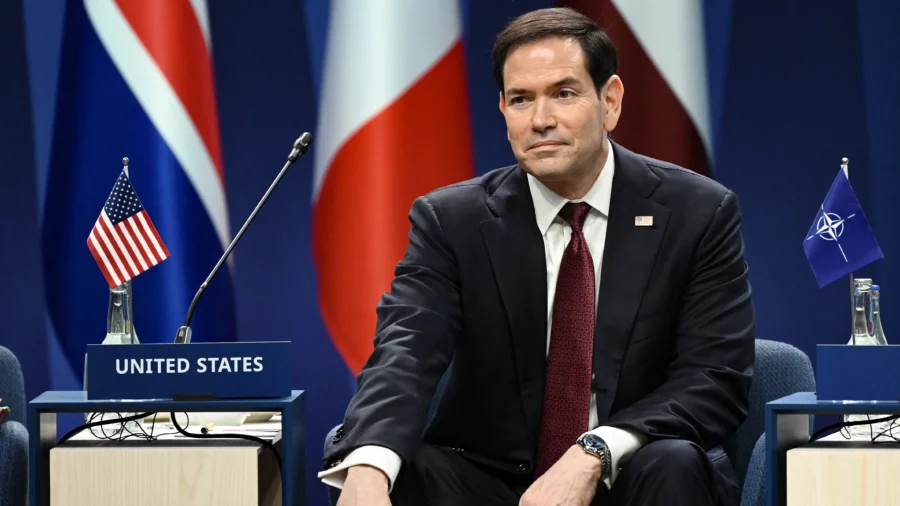
A change in Western global security is underway, according to a U.S. official, and as a result, European allies can expect a reduction of American military forces in their countries.
U.S. European Command estimates that the United States currently has up to some 90,000 military personnel stationed across the continent under the North Atlantic Treaty Organization (NATO) force framework.
“I think it's well understood in the Alliance that the United States troop presence in Europe is going to be adjusted,” Secretary of State Marco Rubio said. “That work was already ongoing, and it's being done in coordination with our allies.”
He added that the United States has obligations in the Indo-Pacific, the Middle East, and the Western Hemisphere.
“Every country has to constantly reevaluate what their needs are, what their commitments are around the world, and how to properly structure that,” Rubio said.
NATO was founded in 1949 to defend Western Europe.
Rubio also discussed the need for a backup plan concerning the Strait of Hormuz stalemate in the event that diplomatic efforts with Iran through Pakistan stall.
"We're dealing with a very difficult group of people, and if it doesn't change, then the president's been clear he has other options," Rubio said. "He prefers the negotiated option and having a good deal, but he himself has expressed concern that maybe that's not possible. We're going to keep trying. I know our guys are still working on that very hard."
Earlier in the month of May, U.S. War Secretary Pete Hegseth announced Project Freedom, a new military operation that aims to restore commerce throughout the Strait of Hormuz, which is an international waterway bordered by Iran, Oman, and the United Arab Emirates.
U.S. officials believe naval sea mines have been planted in the Strait to interfere with passage. The mines hover underwater or sit on the ocean floor.
Rubio stressed that whether Project Freedom is successful or not, there is a role for European allies to play in the matter.
“Let's say Iran decides to open the straits and stop shooting at people, someone's still going to have to go in and reduce the mines, and some of these countries have a lot of mine sweepers, so they could play a key role,” he said.
The goals of Project Freedom include providing 24-hour protection with a red, white, and blue dome over the Strait, enforcing the U.S. blockade, ending Iran’s tolling system, and preventing potential shortages of energy worldwide.
“If Iran refuses to open the Strait, then someone's going to have to go in and do something about it,” Rubio added. “That doesn't mean we couldn't do it. We could. The United States could do it but there are countries that have expressed an interest in potentially being a part of something like that.”