


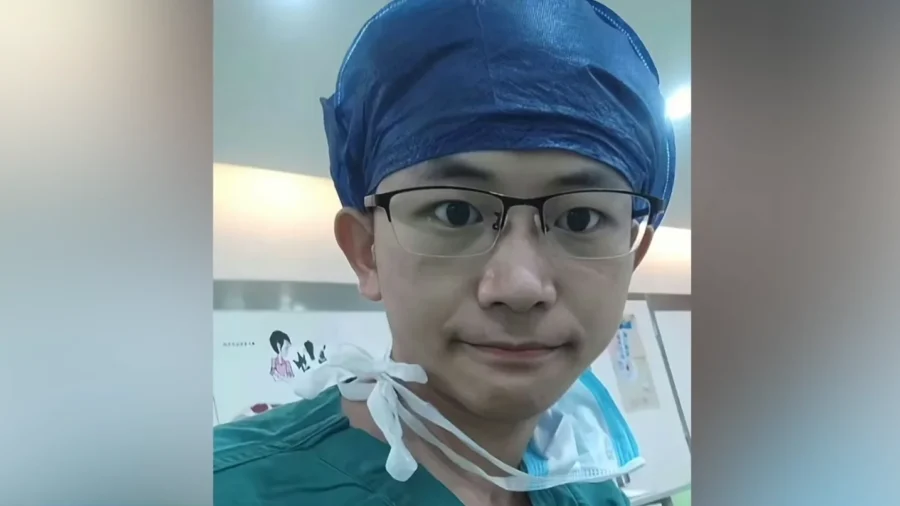
A grieving father is challenging the narrative from China's state-run media over his son's mysterious death. The case involves Luo Shuaiyu, a Chinese medical student who died in May, 2024 after falling from his apartment building. Authorities closed the investigation just last week, calling his death a suicide.
But Luo's parents tell a different story. They say their son was a whistleblower who exposed the forced organ harvesting. Luo's parents say files discovered on their son's computer point to evidence of forced organ harvesting and illegal transplant activities in China.
NTD obtained this audio recording from Luo's phone.
Voice of Transplant Program Staff (Name Unknown) at Second Xiangya Hospital, Central South University:
"Group children aged 3 to 9 into two groups: 3 to 5 years old and 6 to 9 years old, with three males and three females in each group–six cases per group."
"These samples [children] aren’t collected all at once; the process will likely take a long time. So, you should take this chance to get familiar with how to acquire them–how to acquire the organs."
Luo’s father says his son received this phone call from his medical school soon after being accepted. The family believes Luo may have been murdered because he tried to blow the whistle on the crime, and because he refused to source organs from children.
Luo's father took to China's social media platform Weibo last Friday to share this message.
"On Aug. 28, 2024, we submitted evidence to the Changsha police bureau exposing illegal organ harvesting and trafficking involving the Second Xiangya Hospital of Central South University," said the father of deceased medical student Luo Shuaiyu, on June 13. "But to this day, we have received no response."
Luo Shuaiyu was a medical graduate student at China's Central South University. He also interned at the university's affiliated hospital, the Second Xiangya Hospital. U.S. public medical records show Luo was a kidney transplant researcher who worked directly with transplant data in China.
Luo Shuaiyu was found dead in May last year after apparently falling from a residential building.
The incident took place just one month after he made a public whistleblower report, accusing the hospital and its doctors of harvesting organs from live patients and selling them.
Shortly after his death, the hospital requested that Luo's family sign agreements acknowledging his death was a suicide—even though no official investigation had taken place. Later, Luo's family found extensive evidence on his computer accusing hospital doctors of forcibly taking organs from patients without consent and selling them for huge profits. This has led them to suspect foul play in their son's death.
What's more, after initially submitting their evidence to China's health authorities, Luo's father says he was contacted with a shocking settlement offer: more than US$2 million. He refused the offer.
Now, one year after Luo's death, Beijing's state-owned broadcaster aired a report last week dismissing all of the allegations related to his possible murder and to organ harvesting in China.
Luo's parents strongly reject the report—and their stance is resonating with many Chinese internet users. The Luo family is now demanding a full investigation into China's transplant industry.
In 2007, a U.S.-based NGO investigating the persecution of Falun Gong blacklisted the same hospital and its doctors for allegedly harvesting organs from live Falun Gong practitioners. Falun Gong is a spiritual practice based on the principles of truthfulness, compassion, and tolerance. The practice has been brutally persecuted by the Chinese Communist Party since 1999.
The NGO's leader accused the CCP of orchestrating this brutal crime, saying the hospitals involved were "openly engaging in the murder of innocent people for profit." He said the main victims were Falun Gong practitioners.
In light of mounting evidence, several U.S. states, including Texas and Idaho, have passed legislation restricting residents from obtaining organ transplants in China.