


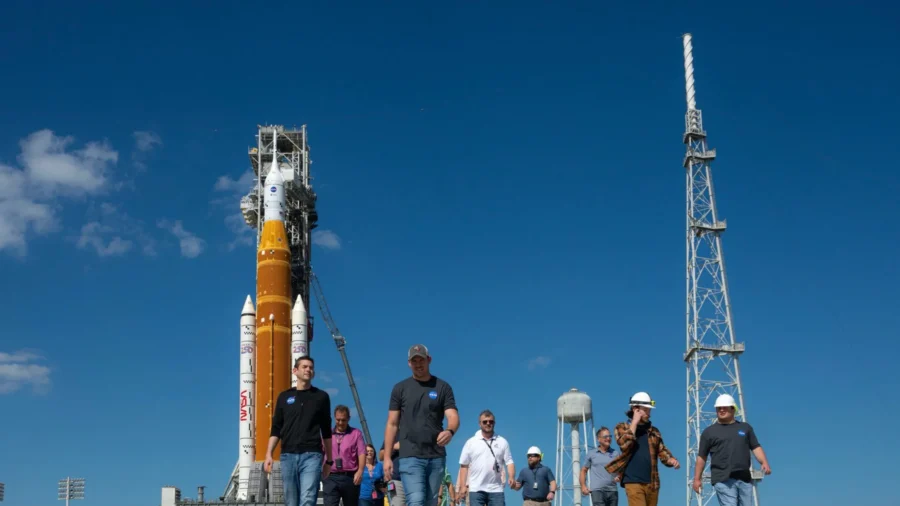
NASA administrator Jared Isaacman announced sweeping changes to the Artemis moon program on Feb. 27, adding an extra mission next year to better prepare for a lunar landing in 2028.
“The idea is we want to reduce complexity to the greatest extent possible,” he said at a press conference at the Kennedy Space Center. “We want to accelerate manufacturing, pull in the hardware, and increase launch rate, which obviously has a direct safety consideration to it as well.”
The major overhaul called for accelerating its moon rocket development to service a greater number of less complex missions within the next two years. It also opens up the opportunity to add one more lunar landing attempt in 2028. But that meant two upcoming missions had to be completely repurposed.
Originally, the Artemis III mission was tasked with making a lunar landing sometime in 2028. Now, Isaacman said it will fly in mid-2027, remaining in Earth orbit. There, the crew will practice rendezvous and docking maneuvers with the lunar landing spacecraft made by SpaceX and Blue Origin, and possibly test spacesuits designed by Axiom Space for walking on the moon.
The following mission, Artemis IV, was to focus on installing the first segment of the upcoming Gateway space station in lunar orbit in 2028. Now, its crew will have the chance to make the first footprints on the moon in more than 50 years.
This changeup comes after Isaacman declared the program’s current pace too slow, with a large jump in steps between missions. He noted a three-year gap between missions in the Artemis program.
Apollo missions, meanwhile, were taking smaller steps with each mission, launching within mere months of each other.
Isaacman also announced plans to standardize moon rocket development, restrengthen NASA’s workforce, and accelerate production to the point that a moon rocket could launch every 10 months instead of three years.
That frequency would secure two possibilities to land humans on the moon in 2028—once at the beginning of the year, and another at the end of the year.
Meanwhile, Artemis II’s mission will remain the same. Over its imminent 10-day mission, NASA astronauts Reid Wiseman, Victor Glover, and Christina Koch, as well as Canadian Space Agency astronaut Jeremy Hansen, will become the first humans to fly around the moon in more than 50 years, reminiscent of Apollo 8 in 1968. Work is underway in Florida to fix problems with the moon rocket to launch that flight by early April.
Artemis III would then mirror Apollo 9, which tested the lunar module and lunar surface space suits in low Earth orbit in early 1969 before attempting the Apollo 11-level lunar landing.
However, NASA said it would talk with its commercial partners before confirming Artemis III’s exact mission objectives.
After that, Isaacman said he wanted to secure two launch opportunities to land on the moon in 2028, one at the beginning and one at the end of the year. He stressed at the press conference that the goal was to secure the opportunity rather than confirm two moon landings in one year.
As far as how the private contractors building the rocket and lawmakers in Congress felt about it, Isaacman said that his announcement comes without surprise. He said he had conversations about this, and everyone he spoke to agreed it was “the only way forward.”
“They know this is how NASA changed the world, and this is how NASA is going to do it again,” he said.